Agentic AI for Business Operations Guide in 2026

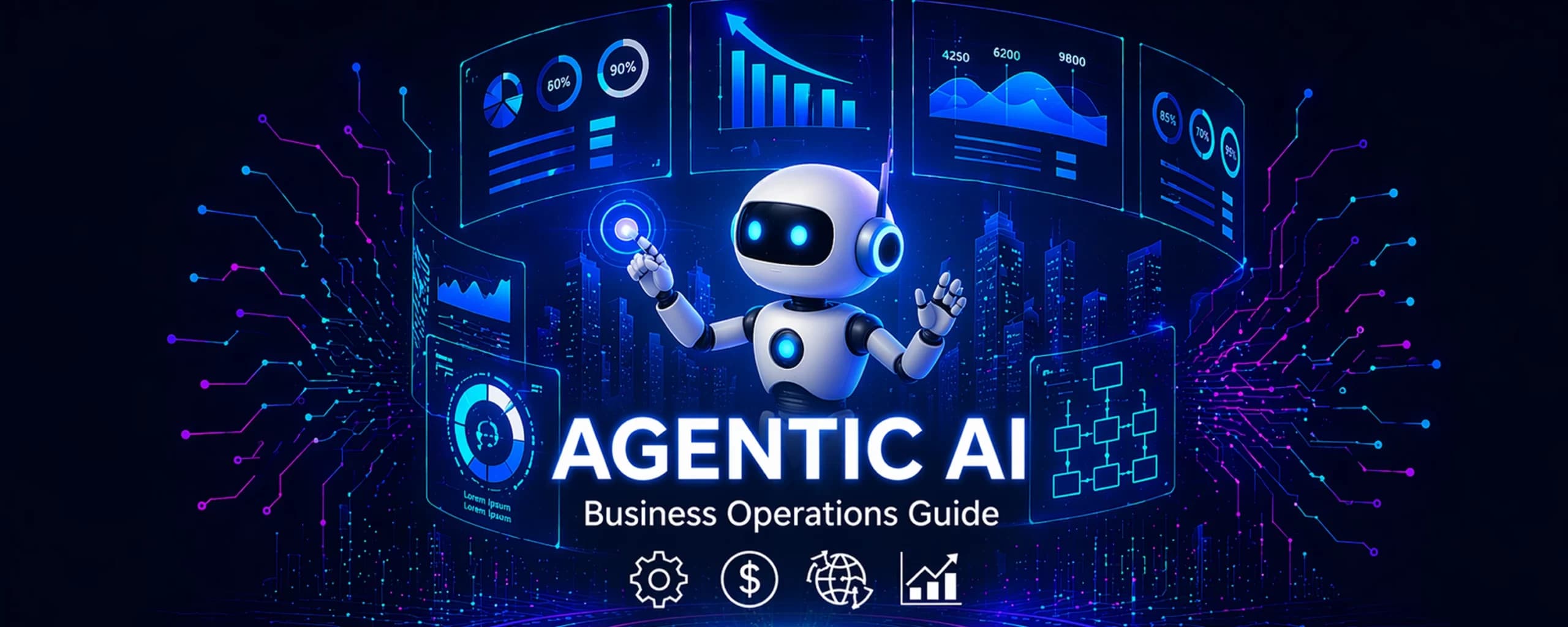
Agentic AI represents a shift in artificial intelligence from reactive tools to proactive systems. These AI agents operate with autonomy, making decisions and executing tasks based on predefined goals. In business operations, understanding agentic AI starts with recognizing how it mimics human-like reasoning to handle repetitive or complex workflows.
An AI agent that not only responds to customer inquiries but anticipates needs, updates records, and escalates issues without human input is no longer a distant concept.
Early adopters of Agentic AI report up to 40% faster process cycles. Success depends on clear goals, though. Without them, AI can create silos or errors. Start by mapping your operations pain points, like delayed reporting or siloed data.
The Role of Agentic AI for Business Operations Guide
Business operations encompass everything from supply chain management to customer service. Agentic AI integrates seamlessly, acting as a virtual workforce. In logistics, for instance, an AI agent can monitor shipments, predict delays, and reroute resources autonomously.
Inefficient processes cost US businesses $1.5 trillion annually in lost productivity. Agentic AI addresses this by automating routine tasks, allowing humans to focus on innovation. Consider a retail operation where AI agents handle inventory checks, forecast demand, and negotiate with suppliers based on market data.
Key advantages include scalability and 24/7 availability. Unlike static bots, agentic systems evolve with your business. A mid-sized e-commerce firm might deploy an agent to process orders, reducing fulfillment time from days to hours.
| Aspect | Traditional Automation | Agentic AI |
| Decision-Making | Rule-based only | Autonomous and adaptive |
| Adaptability | Low; requires recoding | High; learns from data |
| Scalability | Limited to scripts | Handles complex workflows |
| Implementation Time | Weeks to months | Days to weeks with partners |
Implementation takeaway: pilot in one area, like order processing, to measure gains before expanding.
Key Applications of Agentic AI for Business Operations
Agentic AI shines across functions, tailored to specific operations challenges. In sales operations, agents qualify leads by analyzing emails and CRM data, prioritizing high-value prospects. This cuts manual research time by 50%, boosting pipeline velocity.
For recruitment, AI agents screen resumes, schedule interviews, and match candidates to roles using natural language processing. A talent operations head can reduce time-to-hire from 45 days to 20, without losing personalization.
Customer experience teams benefit from agents that resolve tickets via chat or voice, integrating with tools like Zendesk. In banking, they verify transactions and flag anomalies in real-time, enhancing compliance.
Logistics managers use agents for route optimization, predicting disruptions from weather or traffic data. An e-commerce example: an agent monitors stock levels, auto-orders supplies, and alerts teams only for exceptions.
- Sales Operations: Automate lead scoring and follow-ups; ROI via 20-30% higher conversion rates.
- Recruitment: Streamline sourcing and onboarding; expect 40% workload reduction for recruiters.
- Customer Support: Handle 70% of routine queries; improve satisfaction scores by 15-25%.
- Logistics: Optimize supply chains; cut costs by 25% through predictive maintenance.
Build vs. Buy: Choosing the Right Agentic AI Path
Deciding between building agentic AI in-house or buying a solution is crucial. Building offers customization but demands expertise and time, often 6-12 months and $100K+ for a CTO-led team. It’s ideal if you have data scientists and want full ownership.
Buying leverages platforms with pre-built agents, deployable in weeks for $5K-50K initially. For operations with CRMs like Salesforce, off-the-shelf integrations speed adoption. Watch for vendor lock-in, though; choose flexible providers.
| Option | Upfront Cost | Timeline | Pros | Cons |
| Build | $50K-300K | 3-12 months | Total control, tailored | High risk, resource-heavy |
| Buy | $5K-100K | 2-8 weeks | Quick ROI, support | Less customization |
Hybrid approaches work best: buy core agents and build extensions. For US enterprises, compliance requirements like GDPR or CCPA favor buy options with built-in security. Takeaway: assess tech maturity. If you’re already using ATS or ERP, buying accelerates value without disrupting workflows.
Step-by-Step Implementation Guide for Agentic AI
Rolling out agentic AI requires a structured approach. First, audit operations: identify bottlenecks using process mapping and set clear goals, such as reducing support tickets by 40%.
Next, select technology that integrates with existing systems, CRMs for sales and ERPs for logistics. Data quality is key; clean datasets ensure accurate actions.
A phased rollout minimizes risks:
- Planning (1-2 weeks): Define use cases and KPIs, like cost per lead or hire time.
- Development/Setup (2-4 weeks): Configure agents; test in sandbox environments.
- Deployment (1-2 weeks): Launch pilots with 10-20% of volume; monitor for errors.
- Optimization (Ongoing): Use analytics to refine; scale to full operations.
Timelines vary: simple chat agents go live in days, multi-agent systems in months. Budget $10K-50K for mid-market pilots. Example: a healthcare firm implements recruitment agents, cutting screening time by 60% in three months.
Resistance to change is a common challenge, so train teams early. Takeaway: partner with experts for seamless integrations, ensuring 90% uptime from day one.
Measuring ROI and Scaling Agentic AI Success
ROI from agentic AI comes quickly if tracked properly. Key metrics include time saved, cost reductions, and output gains. For operations, aim for 20-40% efficiency boosts in the first quarter.
Calculate ROI as (Gains – Costs) / Costs x 100. Gains include labor savings of $20-40 per hour avoided and revenue uplift, like 15% faster sales cycles.
Track via dashboards:
- Efficiency: Tasks automated per agent.
- Cost: Pre/post implementation expenses.
- Quality: Error rates and satisfaction scores.
A logistics example: agents reduce delays, saving $50K monthly in penalties. Scale by adding agents for adjacent functions, like finance approvals.
Conservative benchmarks: 3-6 month payback for buy options, 6-12 for builds. Mitigate over-automation risks with human oversight loops. Takeaway: review quarterly and adjust goals to sustain 25-50% annual improvements.
Agentic AI equips operations leaders to harness autonomous systems for lasting efficiency. By addressing manual workloads and disconnected tools, it drives growth without proportional costs.
Platforms like Isometrik AI help organizations deploy production-ready AI agents without long development cycles. Their expertise in custom workflows ensures seamless integration, delivering operational efficiency tailored to your business needs.