AI Agent Use Cases: How Businesses Are Scaling Growth

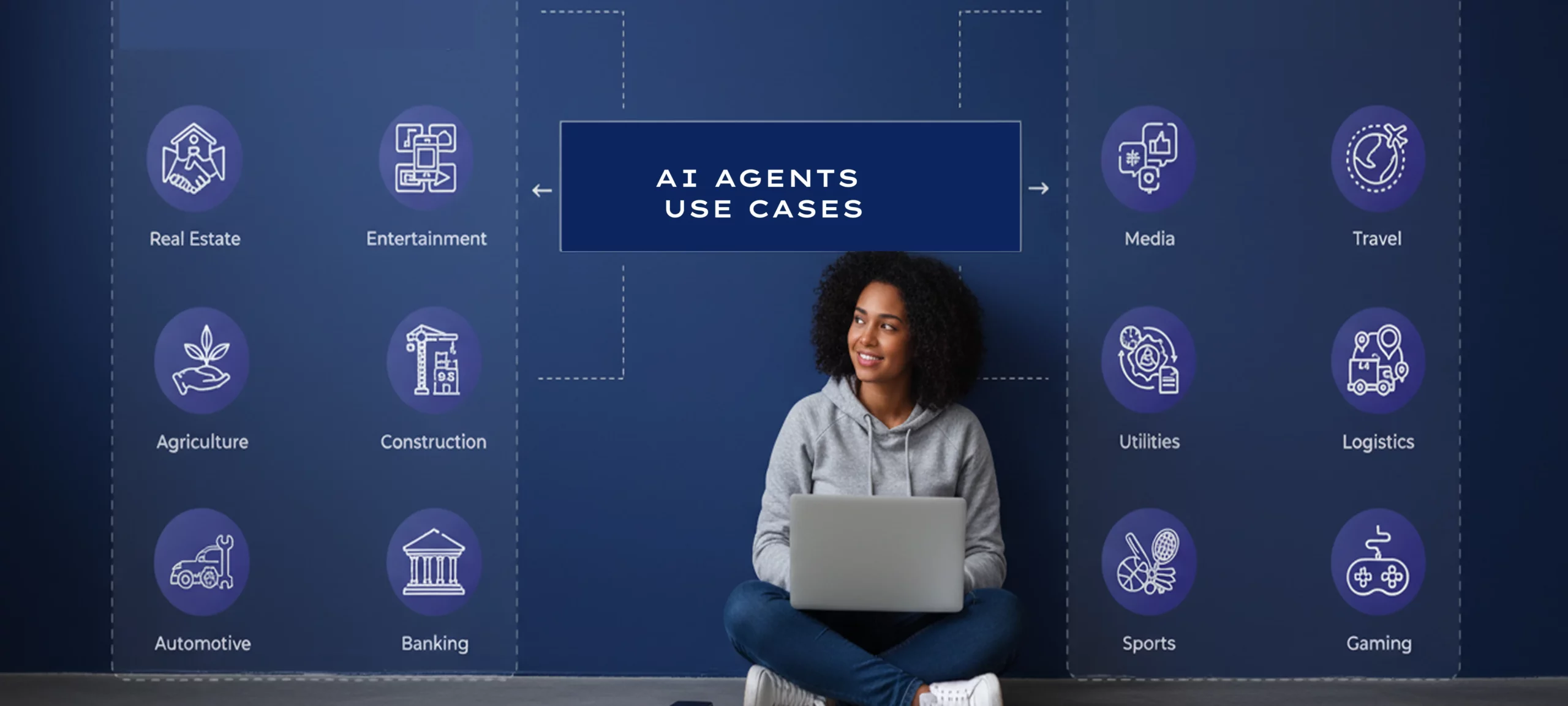
The AI agent market is exploding—from $5.4 billion in 2024 to $47.1 billion by 2030. What matters: 62% of organizations already use AI agents, with adopters reporting 6-10% revenue increases and top performers hitting 18% ROI.
AI agent use cases differ from traditional automation because agents maintain context, plan multi-step workflows, and adjust strategies in real-time. They operate through goal setting, planning, memory, execution, and action—all working autonomously to achieve business outcomes.
Let’s explore AI agent use cases delivering measurable results across three industries transforming fastest in 2025.
How AI Agents Work: The Framework Behind Results
Every effective AI agent operates through five interconnected components:
- Goal Definition: Establishes clear objectives like maximizing conversions or cutting costs
- Planning Layer: Uses LLMs and external tools to map workflows and action sequences
- Memory Component: Stores past actions and context to inform future decisions
- Execution Engine: Generates action plans from data patterns and historical outcomes
- Action Interface: Integrates directly with systems to execute decisions autonomously
This architecture enables complex processes requiring judgment and adaptation. Companies report 6-10% revenue increases, with high performers achieving 18% ROI.
AI Agent Use Cases in E-commerce and Retail
Retail has transformed as AI agents handle everything from inventory to customer engagement. Here’s what’s delivering results.
Personalized Shopping at Scale
AI agents analyze customer behavior, purchase history, and real-time data to deliver hyper-personalized recommendations. Unlike basic engines, these agents adapt instantly, factoring in weather, trends, and inventory. Result: 69% of retailers report 5-15% revenue increases.
Modern shopping agents compare prices, track deals, alert customers to restocks, and complete authorized purchases. Currently, 24% of consumers trust AI to shop for them, with Gen Z adoption at 32%.
Intelligent Inventory Management
AI agents monitor stock levels, predict demand, and trigger automatic reorders before stockouts. They analyze sales data, seasonal trends, and supplier performance to optimize inventory across locations.
Key benefits retail businesses are seeing:
- Reduced carrying costs through predictive stocking patterns
- Minimized stockouts and overstock situations
- Automated supplier negotiations based on volume
- Real-time inventory distribution across fulfillment centers
- Dynamic pricing adjustments based on demand forecasts
| Inventory Metric | Traditional Systems | AI Agent Systems | Improvement |
| Stockout Reduction | 15-20% | 45-60% | 3x Better |
| Carrying Cost | Baseline | 25-30% Lower | Major Savings |
| Forecast Accuracy | 70-75% | 90-95% | +20-25 Points |
| Reorder Response Time | 2-3 days | Real-time | Instant |
Customer Service That Delivers
Customer service AI agents evolved beyond scripts. They handle complex conversations, access complete histories, and coordinate with human agents intelligently. By 2029, AI agents will resolve 80% of common issues autonomously.
These agents learn from every interaction and escalate appropriately. Result: 85% of reps report major time savings for complex cases needing human empathy.
AI Agent Use Cases Transforming Healthcare
Healthcare faces unique challenges—complex regulations, high stakes, massive data volumes. AI agents prove their value across clinical and administrative functions.
Predictive Patient Care
Healthcare AI agents continuously analyze patient data, monitor vitals, and flag complications before they become critical. They cross-reference histories with medical literature for personalized protocols. Mayo Clinic’s AI agents achieved 89% diagnostic accuracy while cutting diagnostic time 60%.
These agents augment clinical decisions by processing data volumes impossible for humans to analyze in real-time. They monitor drug interactions, track treatment efficacy, and alert providers to concerning trends.
Administrative Workflow Automation
Administrative burden crushes healthcare. AI agents handle tasks consuming hours of staff time daily.
Common healthcare AI agent applications:
- Automated insurance verification and prior authorization
- Patient scheduling across providers and facilities
- Medical billing with real-time error detection
- Supply chain management for equipment
- Compliance monitoring and automated reporting
- Patient follow-up and appointment reminders
| Healthcare Metric | Before AI Agents | With AI Agents | Impact |
| Hospital Adoption Rate | 45% (2024) | 90% (2025) | Rapid Growth |
| Diagnostic Errors | Baseline | 45% Reduction | Major Safety Gain |
| Annual Cost Savings | – | $1M+ per facility | Significant ROI |
| Administrative Time | 100% | 40% Reduction | Staff Efficiency |
By 2025, 90% of hospitals expect AI agents for predictive analytics. Hospitals see 45% fewer diagnostic errors and save over $1 million annually.
Research and Drug Discovery
AI agents compress research timelines from years to months. They analyze medical databases, identify trial patterns, and suggest drug combinations. Working 24/7, agents screen thousands of compounds and predict protein interactions.
The FDA’s 2025 framework accelerated approvals—127 new AI medical devices in the first half of 2025, unleashing innovation while maintaining safety.
AI Agent Use Cases in Professional Services
Professional services firms leverage AI agents to deliver higher client value while managing costs. These use cases focus on knowledge work requiring speed and accuracy.
Legal Research and Document Analysis
Legal AI agents review thousands of contract pages, case law, and regulations in hours. They identify precedents, flag inconsistencies, and extract clauses with attorney-level precision. Firms report 70% case prep reductions and 30% fewer errors.
What legal AI agents handle today:
- Contract analysis and clause extraction across jurisdictions
- Due diligence document review for M&A transactions
- Regulatory compliance monitoring with automatic alerts
- Legal precedent research with intelligent ranking
- eDiscovery processing with context-aware filtering
- Patent prior art searches and filing preparation
Client Management and Business Development
AI agents transform client relationships by analyzing communication patterns, identifying cross-selling opportunities, and alerting teams to issues before clients raise concerns.
| Function | Manual Time | AI Agent Time | Quality Gain |
| Client Research | 3-4 hours | 15-20 minutes | +40% depth |
| Proposal Creation | 8-10 hours | 2-3 hours | +25% personalization |
| Risk Assessment | 5-6 hours | 30-45 minutes | +35% accuracy |
These agents pull data from CRMs, emails, and project tools for comprehensive intelligence. Service providers report 35% faster response times and 20% revenue growth.
Financial Analysis and Advisory
Accounting firms use AI agents for complex analyses traditionally requiring senior staff. Agents process statements, identify trends, and generate strategic insights.
For wealth management, AI agents craft investment strategies based on market conditions, risk tolerance, and goals. They monitor portfolios and alert advisors to opportunities. Financial institutions project 38% profitability increases by 2035.
Implementation: Making AI Agents Work
Success requires strategic implementation aligned with business goals.
Critical success factors:
- Clear ROI metrics defined before implementation
- Workflow redesign to maximize effectiveness
- Integration with existing systems and data sources
- Ongoing monitoring and optimization cycles
- Human oversight for high-stakes decisions
- Compliance frameworks built into architecture
| Factor | Traditional | AI Agent Best Practice | Time to Value |
| Deployment | Custom build | Pre-built + customization | 6-8 weeks vs 6+ months |
| Integration | Bolt-on | Complete redesign | Critical for ROI |
| Measurement | Efficiency only | Growth + innovation | High performers focus here |
Organizations achieving 18% ROI treat AI agents as transformation catalysts. Half redesign workflows around agent capabilities. Pre-built AI agents can be operational in 6-8 weeks versus 6+ months for custom development.
The Bottom Line on AI Agent Use Cases
Companies see tangible results: e-commerce businesses boost revenue 15%, healthcare organizations cut diagnostic time 60%, professional services firms reduce case prep 70%. Success demands strategic thinking about automation targets, workflow integration, and outcome measurement.
Winners start with clear goals, choose use cases aligned with strengths, and commit to optimization. The technology is proven, use cases are clear, and competitive advantage awaits.
Ready to explore AI agents for your operations? Contact Isometrik AI to discuss which use cases fit your business.