AI Agent vs Chatbot: Find Which One Fits Your Business

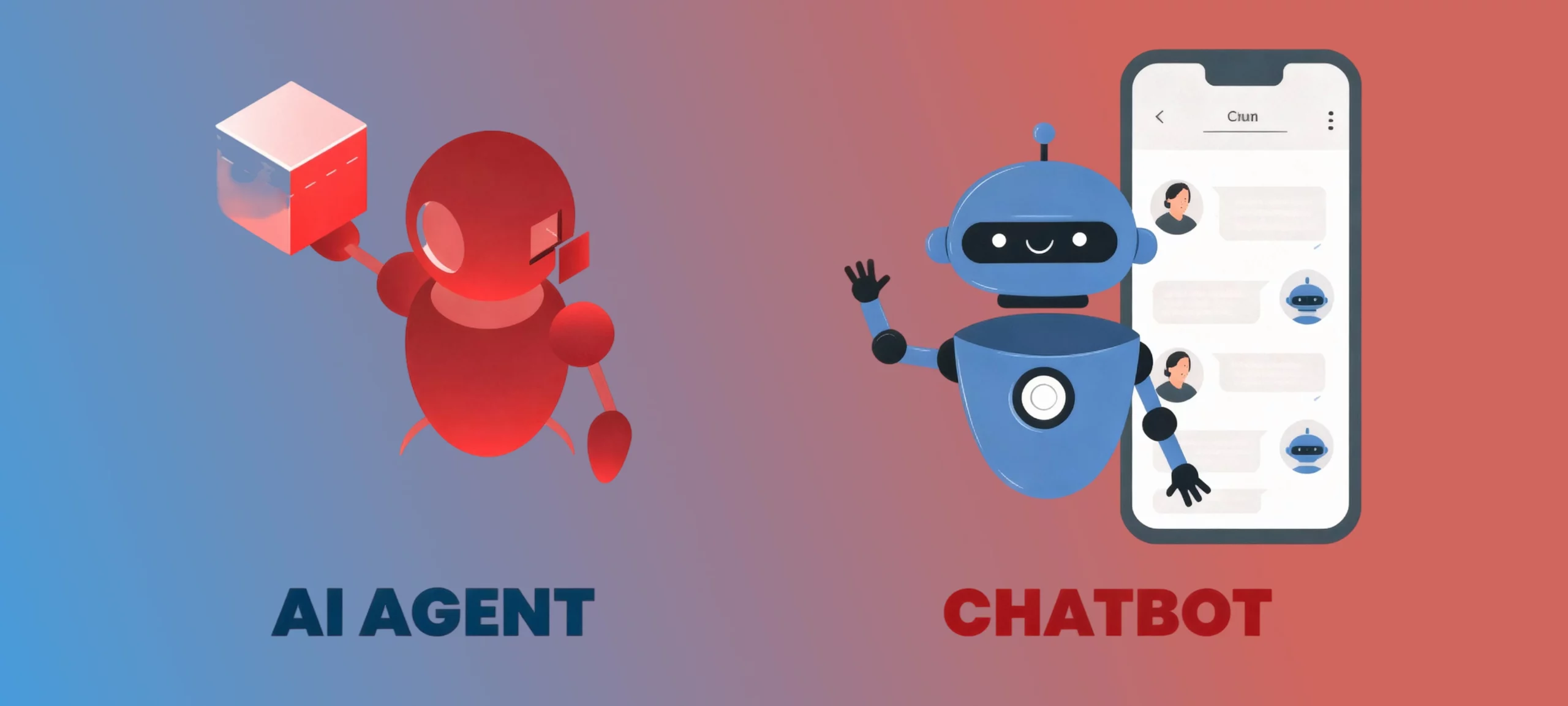
Businesses face a critical choice when automating customer interactions and internal workflows. Should you deploy a chatbot or invest in an AI agent? While both promise efficiency gains, they operate on fundamentally different levels of sophistication.
Understanding the AI agent vs chatbot distinction directly impacts your bottom line, customer satisfaction, and operational scalability.
Over 85% of companies now use AI in some capacity, yet many struggle to match the right technology to their specific needs. Pick wrong and you’ll face frustrated customers, wasted budgets, and stagnant automation.
The confusion is understandable. Both technologies use NLP and hold conversations with users. Both promise reduced costs and improved customer experiences. But beneath the surface, their capabilities diverge dramatically.
Let’s cut through the noise and break down what separates these technologies, when each makes sense, and how to make the smart call for your business.
What Makes AI Agents and Chatbots Different?
AI agents and chatbots might seem interchangeable at first glance, but the capabilities beneath the surface tell a dramatically different story.
Traditional Chatbots
Traditional chatbots are conversational programs that respond based on predefined rules and scripted responses. Think of them as digital assistants following a flowchart.
They excel at answering FAQs, providing basic information, and handling straightforward tasks like checking account balances or booking appointments.
Modern chatbots use natural language processing to understand language patterns and user intent, but their responses remain fundamentally limited to their programming.
Ask about store hours and it pulls from its knowledge base. Request shipping information and it queries a database. Everything operates within predetermined boundaries set by developers.
AI Agents
AI agents represent a quantum leap in capability. These are autonomous systems powered by large language models and advanced machine learning algorithms. They don’t just respond—they reason, plan, and execute multi-step tasks independently across platforms.
An AI agent can access external data sources in real-time, make context-based decisions, learn from past interactions, and dynamically adapt behavior to achieve specific goals. Where chatbots react to input, AI agents take initiative.
They identify problems, formulate solutions, and execute actions without waiting for human direction.
The real game-changer? AI agents possess true “agency”—the ability to set their own objectives, break them into subtasks, and work autonomously toward completion.
This transforms them from simple question-answering tools into intelligent digital workers capable of handling complex, open-ended challenges across multiple business systems.
AI Agent vs Chatbot: Breaking Down the Key Differences
What does this mean for your business? Here’s where the rubber meets the road.
| Feature | Chatbot | AI Agent |
| Decision-Making | Rule-based, follows scripts | Autonomous, context-aware reasoning |
| Learning | Static unless manually updated | Continuous learning from interactions |
| Task Complexity | Simple, single-step queries | Multi-step, cross-platform workflows |
| Data Access | Pre-programmed knowledge | Real-time, multiple data sources |
| Integration | Basic API connections | Deep CRM, database, tool integration |
| Cost | Lower upfront, limited ROI | Higher initial, scalable ROI |
Autonomy makes the difference.
Chatbots respond to user input within defined parameters. AI agents proactively identify problems, break down objectives into subtasks, and execute solutions independently. A chatbot tells order status.
An AI agent detects shipping delays, notifies customers, offers alternatives, and processes refunds—without human oversight.
Learning and memory separate performance levels.
Chatbots don’t retain context between sessions. AI agents maintain memory across interactions, building understanding of user preferences and patterns. This enables increasingly personalized responses over time.
Chatbots handle predictable conversations efficiently. AI agents tackle unpredictable challenges intelligently.
When to Choose a Chatbot vs When You Need an AI Agent
Not every business problem requires AI agent firepower. Sometimes a well-designed chatbot is exactly what you need. Here’s how to make the right call.
Choose a chatbot when:
- Interactions follow predictable patterns with clear, simple resolutions
- You need 24/7 availability for routine inquiries and standard requests
- Budget constraints require immediate cost savings with quick deployment
- Questions typically resolve in one or two exchanges
- Responses can be standardized without losing effectiveness
Chatbots work great for password resets, appointment scheduling, order tracking, basic product inquiries, and directing customers to appropriate resources.
They’re the no-brainer choice for handling high volumes of repetitive questions that don’t require judgment calls or complex reasoning.
Deploy an AI agent when:
- Tasks involve multiple sequential steps across different systems or platforms
- Decisions require analyzing diverse data sources and business context
- Personalization significantly impacts outcomes and customer satisfaction
- Processes benefit from continuous improvement and adaptive learning
- You need truly autonomous operation for complex, dynamic workflows
AI agents shine in personalized healthcare treatment recommendations that consider patient history and current conditions, dynamic recruitment screening that adapts based on candidate responses, predictive e-commerce experiences that anticipate needs, and supply chain optimization that self-corrects based on real-time market conditions.
| Business Scenario | Chatbot Works | AI Agent Needed | Why |
| Return policy questions | ✓ | Simple information retrieval | |
| Personalized care plans | ✓ | Analyzes medical history, conditions | |
| Product recommendations | ✓ | Basic filtering works | |
| Outfit coordination | ✓ | Style analysis, inventory matching | |
| Job application screening | ✓ | Initial requirement check | |
| Skills assessment | ✓ | Adaptive testing, evaluation | |
| Order status check | ✓ | Direct database lookup | |
| Shipping issue resolution | ✓ | Problem analysis, coordination |
Consider your growth trajectory. Chatbots offer quick wins and immediate cost reduction for stable, predictable operations. AI agents deliver compounding returns as they learn, making them essential for businesses scaling rapidly or facing increasing operational complexity.
How AI Agents and Chatbots Transform Healthcare, E-commerce, and Recruitment
Real-world applications reveal where each technology delivers value.
Healthcare: From Scheduling to Personalized Care
Chatbots handle appointment bookings, medication reminders, and basic symptom triage. They answer questions about services and insurance. These functions reduce call center volume by 30-40%.
AI agents revolutionize care through intelligent diagnosis support and personalized treatment planning. They analyze patient histories, lab results, and research to recommend evidence-based options.
WellSpan Health deployed agents that autonomously contact patients, assess health needs, and schedule cancer screenings, reaching over 100 patients quickly.
E-commerce: Product Info vs Predictive Experiences
E-commerce chatbots handle product searches, order tracking, and returns. They guide checkout and answer sizing questions.
AI agents create dynamic shopping experiences that anticipate needs. They analyze browsing behavior, purchase history, and inventory to deliver personalized recommendations.
Retailers see 30% higher conversions and 20% fewer returns. These agents proactively identify opportunities and optimize pricing in real-time.
Recruitment: Resume Screening vs Intelligent Matching
Recruitment chatbots automate interview scheduling, answer position questions, and collect applications.
AI agents transform acquisition through adaptive assessment and predictive matching. They analyze resumes, conduct dynamic evaluations, and assess cultural fit.
Companies fill roles 60% faster while improving candidate quality by 35%. Allegis Group implemented agents that automate profile updates and analyze interactions, achieving significant efficiency improvements.
Making the Right Choice AI Agent vs Chatbot: Implementation Considerations
Beyond capabilities, here’s what matters for deployment.
| Implementation Factor | Chatbot | AI Agent |
| Deployment Time | 2-4 weeks | 6-8 weeks |
| Initial Investment | $5K-$25K | $25K-$100K+ |
| Technical Requirements | Basic API, knowledge base | Robust data infrastructure |
| Data Needs | Simple, structured | Clean, integrated systems |
| Maintenance | Manual updates needed | Self-improving |
| ROI Timeline | Immediate | Compounding over time |
Budget and Timeline
Chatbots offer lower entry barriers with $5,000-$25,000 costs and immediate returns through reduced support expenses. AI agents require $25,000-$100,000+ investment but deliver 60% long-term cost advantages through continuous optimization and scalability.
Technical Infrastructure
Chatbots need basic integrations and a knowledge base—most businesses deploy without significant overhaul. AI agents demand robust data ecosystems with CRM, database, and analytics access. Security frameworks must support autonomous decisions while maintaining regulatory compliance.
Isometrik AI bridges this gap with pre-built agents deployable in 6-8 weeks, 78% faster than custom development. Their Agent Studio enables sophisticated workflows without extensive expertise, maintaining SOC2 and HIPAA compliance. Solutions span basic Conversational AI to AI SDR teams managing complete campaigns autonomously.
The Future of Intelligent Automation: From Chatbots to AI Agents
AI technology is shifting from reactive tools to proactive partners. Chatbots will evolve with better NLP capabilities. Meanwhile, AI agents are becoming increasingly accessible and business-essential.
Multimodal AI agents will combine text, voice, image, and data seamlessly. Integration will deepen, with agents orchestrating entire business ecosystems. Explainability will improve as regulations mature, crucial for regulated industries.
Making Your Move
Start where you are. If needs center on high-volume, predictable interactions, implement a chatbot. Gain experience and collect customer pattern data.
When complexity or personalization become bottlenecks, transition to AI agents. Companies deploying agents now gain compounding advantages through continuous learning.
The AI agent vs chatbot decision isn’t one-size-fits-all. Assess challenges, consider growth trajectory, and choose solutions that scale.
Ready to explore AI solutions for your business? Isometrik AI offers free strategy sessions.