AI Development Agency vs In-House Cost: What Businesses Need to Know

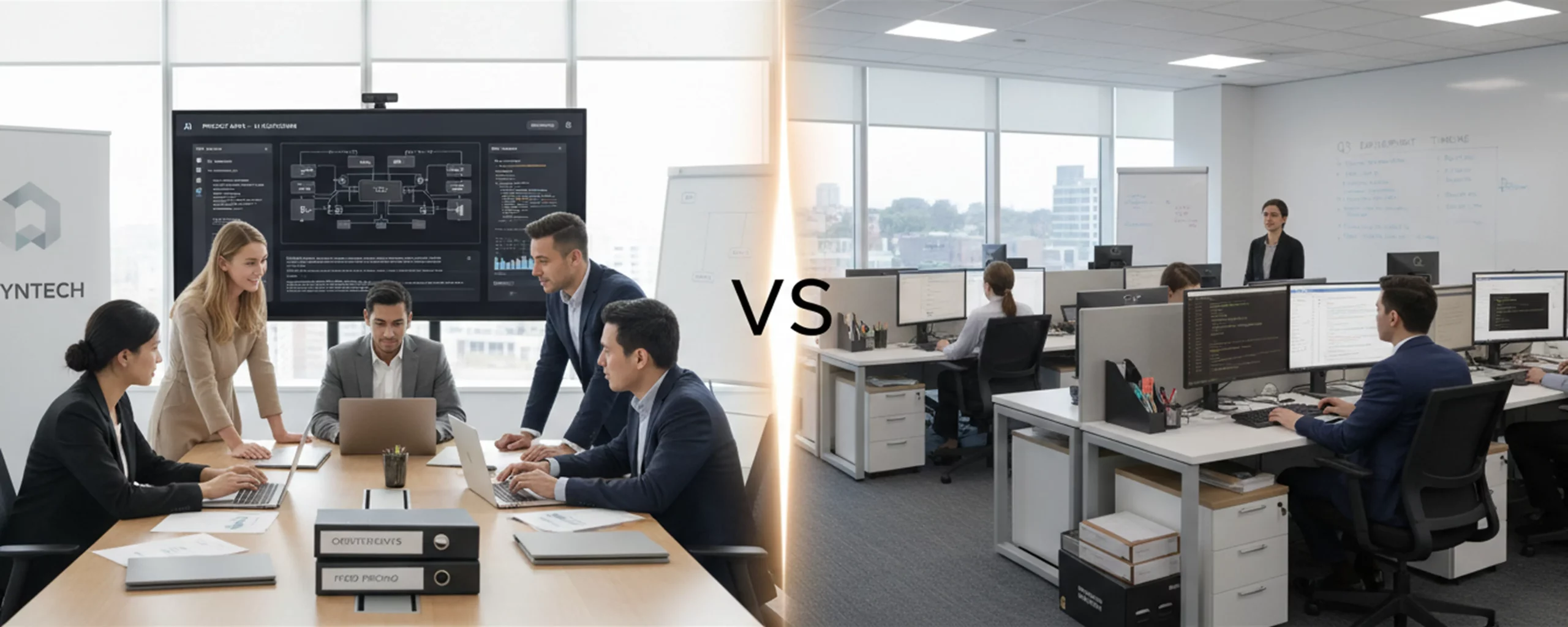
Your leadership team wants AI. Your engineers are already stretched thin. And your CFO wants a number on the whiteboard. The debate over AI development agency vs in-house cost is one of the sharpest budget decisions U.S. businesses face in 2026. It’s not a philosophical question about control or convenience.
It’s a resource-allocation call that directly affects your runway, your product roadmap, and how quickly you put AI to work. Before you sign an offer letter or an agency contract, here’s what the numbers actually show — and what most cost comparisons leave off the spreadsheet entirely.
The Real Price of Building an In-House AI Team
When leadership says “let’s build this ourselves,” the first instinct is to think about salaries. That’s roughly 40% of the real picture. According to the U.S. Bureau of Labor Statistics, benefits and employer overhead add approximately 30% on top of every base salary.
Recruiting fees typically run another 15–20% of first-year compensation. Factor in onboarding time, tooling, and software licenses — and the true first-year cost of each AI hire lands well above the job posting.
To stand up a functioning in-house AI team, you typically need at minimum:
- AI/ML Engineer: $145,000–$180,000/year
- Data Scientist: $120,000–$150,000/year
- Senior Full-Stack Developer: $120,000–$160,000/year
- DevOps / Infrastructure Engineer (50% allocation): $65,000–$85,000/year
- Project Manager / Technical Lead: $110,000–$140,000/year
That puts base salaries alone at $550,000–$770,000 annually for a lean starting team. The table below shows actual annual spend once overhead is applied.
| Role | Base Salary Range | Benefits & Overhead (~30%) | Total Annual Cost |
| AI/ML Engineer | $145K–$200K | $46K–$60K | $190K–$250K |
| Data Scientist | $120K–$160K | $39K–$48K | $149K–$190K |
| Full-Stack Developer | $120K–$170K | $39K–$51K | $145K–$201K |
| DevOps Engineer (50%) | $60K–$90K | $21K–$27K | $81K–$105K |
| Project Manager | $105K–$150K | $36K–$45K | $145K–$175K |
| Total | $550K–$770K | $181K–$231K | $710K–$920+K |
AI Development Agency vs In-House Cost — What the Numbers Actually Show
This is where the comparison sharpens. An AI development agency operates under a fundamentally different financial model. You’re not paying salaries, benefits, or recruiting fees. You pay for outcomes — at a fraction of what an equivalent in-house build would cost.
Agency pricing in 2026 breaks down by project scope:
- Basic AI automation or chatbot: $8,000–$25,000 (project-based)
- Custom AI solution (mid-complexity): $40,000–$80,000
- Enterprise-grade AI platform: $140,000–$350,000+
- Offshore development (hourly): $25–$75/hour
- Pre-built, ready-to-deploy AI agents: Significantly lower than custom development
Research consistently shows outsourcing AI development reduces total costs by 30–50% compared to in-house builds. The side-by-side comparison below makes that gap concrete.
| Factor | In-House Team | AI Development Agency |
| Year-1 total cost | $710K–$920+K | $20K–$400K (by project scope) |
| Time to first deployment | 6–12 months | 6–16 weeks |
| Talent acquisition time | 3–6 months | Immediate |
| Overhead (benefits, tools) | ~30%+ on top of salaries | Included in contract |
| Scalability | Slow; requires new hires | On-demand |
| Project success rate | ~33% reach production | ~67% with proven vendors |
Hidden Costs That Quietly Inflate Your Budget
Most in-house AI cost estimates miss the expenses that surface six months into the build. These aren’t edge cases — they’re standard parts of AI development that first-time builders consistently leave off the budget. Understanding them changes the entire build-vs-buy conversation.
The biggest surprises include:
- Model drift and retraining: AI performance degrades as real-world data shifts. Ongoing retraining accounts for 15–25% of total AI spend annually.
- Cloud infrastructure: Compute costs for training and inference compound quickly. Most teams don’t account for this until the invoices arrive.
- Compliance and security: In healthcare, legal, or finance, regulatory requirements add 20–30% to timeline and budget.
- Talent retention: Replacing a departing AI engineer costs 50–200% of their annual salary — a significant risk in a tight market.
- Failed prototypes: Over 80% of AI models are shelved before production. Each abandoned build is a sunk cost with no business return.
This isn’t a case against AI. It’s a case for honest budgeting. Understanding AI deployment challenges before committing to an in-house path is one of the highest-ROI planning decisions a team can make early on.
Speed, Talent, and the Time-to-Value Problem
For almost 80% of tech leaders, insufficient AI skills and expertise is the primary bottleneck to rolling out AI. The U.S. talent market for AI engineers is among the most competitive in the world. Building an in-house team means entering a bidding war against companies with deeper pockets and more established engineering brands.
What this means in practice:
- You compete with top-tier tech firms for the same limited AI talent
- Salaries are inflated due to high demand
- Hiring cycles are long, delaying project kickoff
- Even after hiring, ramp-up time slows execution
A specialized AI agency arrives with the bench already assembled. They’ve solved your problem category before. They’ve made the costly mistakes on someone else’s budget — and corrected them. That institutional knowledge doesn’t show up on a salary comparison, but it carries real dollar value.
What an AI agency brings immediately:
- Pre-vetted AI engineers, data scientists, and ML specialists
- Experience across similar use cases and industries
- Proven frameworks, accelerators, and deployment playbooks
- Faster onboarding with minimal learning curve
Speed to value matters more than most business leaders account for upfront. Every month of delayed AI deployment is a month your competitors could be compounding ahead. Whether your focus is e-commerce, SaaS, logistics, or healthcare — the cost of waiting is never zero.
The hidden cost of delay:
- Lost revenue opportunities
- Slower product innovation cycles
- Competitive disadvantage in AI adoption
- Delayed ROI realization
McKinsey’s 2025 State of AI report found that businesses using AI in sales and marketing saw revenue growth of 5–10%. Getting to production faster means reaching those returns sooner.
| Factor | In-House Team | AI Development Agency |
| Hiring Time | Long (months) | Immediate |
| Time to Production | Slower | Faster |
| Access to Expertise | Limited initially | Ready from day one |
| Opportunity Cost | High due to delays | Lower due to speed |
Knowing how AI helps businesses grow — and putting a dollar figure on the opportunity cost of delay — often closes the argument faster than the cost comparison alone.
When In-House Makes Sense (and When It Doesn’t)
In-house AI development isn’t the wrong call for every business. It’s the wrong call for most businesses that haven’t yet built AI infrastructure or validated a use case with real users. Here’s a practical decision framework.
| Business Situation | Recommended Path |
| Early-stage startup with limited runway | AI development agency or pre-built solution |
| Established enterprise with an existing AI team | Hybrid or in-house |
| Need deployment in under 3 months | AI development agency |
| Core IP tied directly to a proprietary AI model | In-house (with external oversight) |
| First AI initiative — validating a use case | Agency |
| Regulated industry (healthcare, legal, finance) | Specialized AI development agency |
| Long-term, high-volume AI roadmap | Gradually build internal capability |
| Mid-market business scaling fast | Agency with pre-built agents |
The honest reality: most U.S. startups and mid-market businesses don’t have the runway or hiring leverage to staff a competitive in-house AI team. The talent is scarce and expensive. Outsourcing to a proven agency isn’t a shortcut — it’s the financially sharper move for most organizations at this stage.
How Isometrik AI Bridges the Gap
This is where the comparison moves from spreadsheet to a deployable decision. Isometrik AI is built for businesses that need production-ready AI results — without the overhead, the timeline, or the hiring risk of assembling an internal team from scratch.
Rather than spending 6–12 months recruiting and another 6 months building, Isometrik’s pre-built AI agents go live in 6–8 weeks. They’re proven, production-ready agents — tested and refined across real client deployments — covering sales outreach, customer engagement, voice campaigns, and content operations.
For businesses with unique workflows or proprietary use cases, the AI Product Builder enables custom agent development with enterprise-grade security, full API integrations, and no-code deployment options.
Key advantages:
- 6–8 week deployment — not 6–12 months of hiring and building
- Zero talent acquisition cost — no recruiting cycle, no competing with Big Tech salaries
- Predictable pricing — project-based, not open-ended salary commitments
- Proven at scale — agents refined across real deployments, not internal experiments
- Enterprise-grade security — GDPR, HIPAA, and CCPA-compliant by default
When measuring your AI ROI, speed to deployment is one of the highest-impact variables in the calculation. Every week your AI is live is a week it’s compounding value. Isometrik eliminates the longest, most expensive phase of the entire build.
Bottomline: AI Development Agency vs In-House Cost
The AI development agency vs in-house cost debate doesn’t have a universal answer. But for most U.S. businesses — especially those in the early stages of AI adoption — the math is consistent. Agencies deliver faster, at lower upfront cost, with meaningfully higher success rates.
The real question isn’t whether you can afford to work with an agency. It’s whether you can afford the timeline, the talent competition, and the risk of building alone. If you’re ready to build and deploy an AI agent without the overhead, Isometrik AI is a conversation worth having.