AI in Healthcare Examples: Real Applications Transforming Medicine

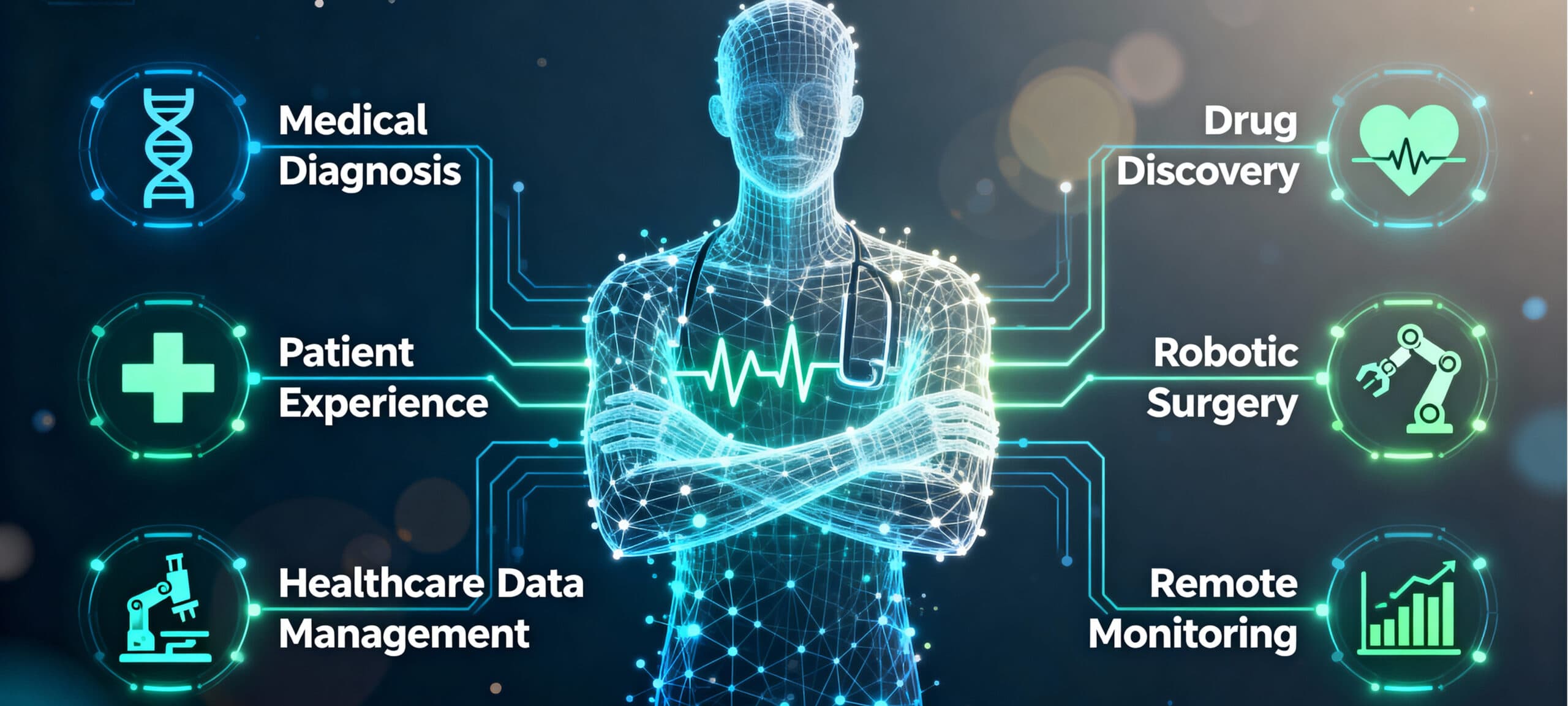
AI in healthcare examples are everywhere you look in 2026. From diagnosing cancer with superhuman accuracy to discovering new drugs in months instead of years, artificial intelligence is reshaping medicine at breakneck speed.
Healthcare systems worldwide face mounting pressures. Staff shortages affect 46% of physicians. Administrative tasks consume 2+ hours for every hour of patient care. Rising costs strain budgets while patient volumes grow. AI offers a lifeline, transforming how care gets delivered while improving outcomes.
AI in Healthcare Examples: Medical Imaging Leading the AI Revolution
Medical imaging stands as the most mature AI application in healthcare. AI diagnostic tools can reach very high levels of accuracy. For example, lung cancer detection algorithms have achieved up to 98.7% accuracy, and AI screening for retinal disorders has achieved 95.2% accuracy, supporting faster and more consistent diagnostic decisions.
At Massachusetts General Hospital, AI algorithms detect lung nodules with 94% accuracy compared to 65% for radiologists alone. At Massachusetts General Hospital and MIT, AI algorithms have achieved impressive results in diagnosing conditions. For example, they detected lung nodules with an accuracy of 94%, compared to 65% for radiologists.
Stanford University developed an AI system that outperforms human radiologists in pneumonia detection from chest X-rays. The breakthrough demonstrates machine learning’s transformative potential in medical imaging technology.
Real-World Impact:
- Reduced false positives by 30% in mammography screening
- Cut average report turnaround times from 11.2 days to 2.7 days
- Achieved 92% accuracy in early Alzheimer’s detection
- Enhanced stroke diagnosis timing accuracy
AI correctly identified 92% of patients with Alzheimer’s. A critical point of using computer-aided detection in Alzheimer’s diagnostics is that the algorithm can pick up very early indications of the disease, which radiologists would not be able to detect.
Drug Discovery Acceleration Through AI
Pharmaceutical companies embrace AI to tackle the industry’s biggest challenge: the traditional 10-15 year drug development timeline. Phase 1 trials for AI-discovered drugs have achieved success rates between 80–90%, which is significantly higher than the historical industry averages of 40–65%. For Phase 2 trials, the success rate for AI-discovered molecules is around 40%, which is comparable to historical averages.
Roche implements a “lab in a loop” strategy where AI models analyze massive datasets from lab experiments and clinical studies. These models generate predictions about disease targets and therapeutic molecule designs that get tested experimentally.
The ‘lab in a loop’ strategy involves training AI models with massive quantities of data generated from lab experiments and clinical studies. These models generate predictions about disease targets and designs of potential medicines that are experimentally tested by our scientists in the lab.
Transformative Applications:
- Target identification and validation
- Synthetic route prediction
- Compound optimization
- Clinical trial design enhancement
- Toxicity prediction
Major pharmaceutical companies like Bayer, Pfizer, and Eli Lilly partner with AI firms to develop therapies in immuno-oncology and cardiovascular diseases. Lilly announced investments in AI-powered manufacturing using machine learning and digitally integrated systems.
Clinical Workflow Automation Saving Time
Ambient scribes represent healthcare AI’s first breakout category. Ambient scribes are healthcare AI’s first breakout category, generating $600 million in 2025 (+2.4x YoY), more revenue and attention than any other clinical application.
These systems listen to patient-doctor conversations, generate clinical notes, and populate electronic health record fields automatically.
Oracle’s implementation at AtlantiCare reduced documentation time by 41% and saved providers 66 minutes daily. Oracle’s work with AtlantiCare reduced documentation time by 41% and saved providers 66 minutes daily.
Operational Benefits:
- Automated clinical documentation
- Real-time patient monitoring
- Medication management
- Appointment scheduling optimization
- Insurance verification streamlining
Predictive Analytics for Better Outcomes
AI excels at identifying patterns humans miss. Healthcare organizations use AI-powered applications to collect broad health signals including device-free biometrics, brain health assessments, and medication scanning.
For example, many provider and payer organizations will begin using AI-powered applications to collect a broad range of health signals, such as device-free biometrics, brain health assessments and medication scanning.
Patient monitoring systems now detect when patients turn over in bed, alerting staff they don’t need manual repositioning. Smart cameras detect patients getting up and alert staff to prevent falls.
Cameras can detect when a patient has turned over in bed, and the platform can alert care team members that they don’t need to turn the patient manually. Some cameras can also detect when a patient is getting up and alert staff so they can prevent a fall.
Predictive Capabilities:
- Early disease risk identification
- Treatment response prediction
- Readmission risk assessment
- Equipment failure prediction
- Staff scheduling optimization
Conversational AI Improving Patient Access
K Health’s AI-powered app compares patient symptoms with millions of anonymized medical records, then connects users with licensed doctors for telemedicine consultations. A great example is K Health, whose AI-powered app compares patient symptoms with millions of anonymized medical records. It then connects users with licensed doctors for telemedicine consultations.
Modern healthcare AI provides multilingual support across 15+ languages, automated appointment scheduling, and symptom assessment guidance. Smart escalation protocols ensure urgent cases reach clinicians immediately while routine queries get resolved automatically.
The Business Case for Healthcare AI
Healthcare AI delivers measurable returns on investment. AI is revolutionizing healthcare in 2025 by improving diagnostics, personalizing treatments, automating administrative tasks, and predicting diseases. These tools are saving time, reducing errors, and cutting costs, with potential savings of up to $150 billion annually in the U.S. alone.
Performance Metrics:
- 45% reduction in diagnostic errors
- 40% decrease in administrative workload
- 25% improvement in patient retention
- 60% faster hiring with better candidate fit
- $1M+ annual cost savings per major hospital
Current adoption shows strong momentum. As of 2025, 54% of U.S. hospitals with over 100 beds report using AI in radiology, primarily for image interpretation (82%) and worklist prioritization (48%).
Implementation Challenges and Solutions
Despite promising results, healthcare AI faces real obstacles. Data quality issues, regulatory requirements, and integration complexities slow adoption. A 2024 study published in Nature Medicine found that chest X-ray models trained at a single institution exhibited up to a 20% drop in diagnostic performance when tested on external datasets, highlighting how hidden biases in training data can severely limit generalizability and patient safety.
Successful implementations require rigorous testing, transparent algorithms, ethical guidelines, and collaboration between humans and machines. Healthcare organizations need robust data governance before deploying AI solutions effectively.
Looking Ahead: The Future of AI in Healthcare
The trajectory is clear. AI will drive significant improvements in clinical trial design, drug manufacturing optimization, and personalized medicine.
Through the application of AI tools on multimodal datasets in the future, we may be able to better understand the cellular basis of disease and the clustering of diseases and patient populations to provide more targeted preventive strategies.
Regulatory frameworks evolve rapidly to match innovation pace. The FDA published draft guidance in 2025 for AI use in drug development, while the European Health Data Space entered force to advance cutting-edge AI solutions with proper data protection.
Traditional healthcare’s reputation as a digital laggard disappears as the industry sets the pace for enterprise AI adoption. Long dismissed as a digital laggard behind on every major innovation wave, healthcare is now setting the pace for enterprise AI adoption.
Ready to Transform Your Healthcare Operations?
As technology advances and adoption accelerates, healthcare organizations that embrace AI gain competitive advantages through improved patient outcomes, reduced costs, and enhanced operational efficiency.
Isometrik AI helps healthcare providers implement HIPAA-compliant AI solutions that reduce staff workload by 60% while improving patient satisfaction. Our conversational AI platform automates patient communication, appointment scheduling, and administrative tasks without disrupting clinical workflows.
Deploy intelligent healthcare automation in 12-16 weeks and join forward-thinking organizations already benefiting from AI transformation. The future of healthcare is here—and it’s powered by artificial intelligence.