AI SDR vs Human SDR Cost Comparison: How You Spend Every Dollar

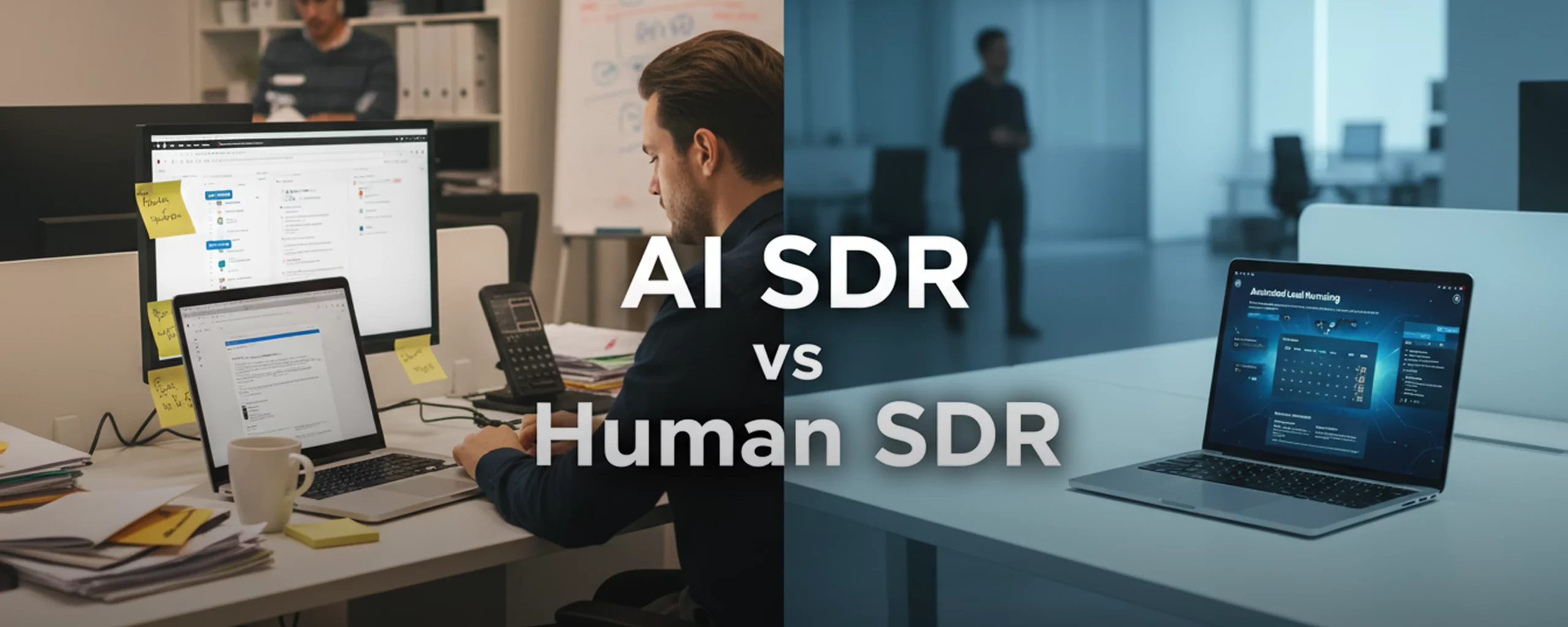
Hiring decisions in B2B sales come down to numbers. The AI SDR vs human SDR cost comparison has moved from water-cooler debate to boardroom agenda—and not without reason. Human SDRs cost far more than most teams realize. AI SDRs deliver far more than most skeptics worry about.
But neither picture holds up without a full line-item breakdown. Our blog covers salary, pricing models, ramp time, turnover, and ROI—everything you need to decide with numbers, and not on just assumptions.
What’s Really in the Price Tag of a Human SDR?
Most hiring managers quote base salary when discussing SDR costs. That number barely scratches the surface. The fully loaded cost of a U.S.-based human SDR runs significantly higher—and the gap between sticker price and true cost is where most budgets unravel.
Base salary for a mid-market SDR typically lands between $45,000 and $70,000 per year. Stack on commissions and performance bonuses, and that figure grows by another $15,000 to $30,000. Benefits—health insurance, retirement contributions, paid time off—add another 20–30% to total package.
Here’s what rarely makes it onto the initial budget sheet:
- Recruiting and interviewing: Sourcing qualified SDRs takes weeks and carries real agency or job board costs.
- Onboarding and training: New hires need 3–6 months before reaching full productivity.
- Management overhead: Daily coaching, pipeline reviews, and performance check-ins demand dedicated time.
- Tool licenses: CRM access, sales engagement platforms, and data enrichment tools run $2,000–$4,000 per rep annually.
- Turnover expense: The average SDR tenure is roughly 16 months. Replacing one costs an estimated 150–200% of annual salary.
When everything is factored in, a single U.S.-based human SDR costs between $90,000 and $140,000 per year. That’s not a salary line—it’s a full business investment with compounding risk attached.
In markets like India, base salaries run lower—typically $14,000–$24,000 annually. But the productivity ceiling, management load, and turnover dynamics remain strikingly similar. Scale still demands a smarter model.
Breaking Down AI SDR Costs: Pricing Models and What You’re Actually Paying
AI SDR platforms don’t follow a one-size-fits-all pricing model. Understanding your options upfront prevents budget surprises down the road.
Most platforms charge a monthly subscription fee. Entry-level plans start around $500 per month. Mid-tier plans with stronger personalization and CRM integration run $1,000–$2,000 monthly. Enterprise-grade platforms with advanced analytics can reach $5,000 per month.
Beyond the subscription, plan for these setup costs:
- Implementation and configuration: One-time setup costs range from $3,000 to $15,000 depending on your tech stack.
- CRM and data integration: Connecting your AI SDR to existing pipeline tools may require additional configuration.
- Ongoing optimization: Someone on your team needs to monitor campaign metrics and refine messaging periodically.
- Email infrastructure: Domain warming, inbox rotation, and deliverability management carry operational requirements.
What you don’t pay for is equally important. No salaries, commissions, benefits, or office overhead. No three-month ramp period where you’re paying someone who isn’t yet producing results.
According to MarketsandMarkets benchmarking data, most organizations see an AI SDR payback period of roughly 3.2 months—compared to 8.7 months for a new human hire. For a deeper look at how these systems are architected, Isometrik’s breakdown of AI SDR agents is a useful starting point.
AI SDR vs Human SDR Cost Comparison: The Full Breakdown
Here’s the complete picture side by side.
| Cost Factor | Human SDR | AI SDR Platform |
| Base compensation | $55,000–$75,000/year | $0 |
| Monthly platform/tool cost | $200–$500 (tools only) | $500–$5,000 |
| Commissions and bonuses | $15,000–$30,000/year | $0 |
| Benefits and overhead | $15,000–$25,000/year | $0 |
| Implementation cost | Recruiting fees + weeks | $3,000–$15,000 one-time |
| Ramp to full productivity | 3–6 months | 2–6 weeks |
| Annual turnover cost | 150–200% of base salary | $0 |
| Total annual cost | $100,000–$150,000 | $12,000–$60,000 |
The cost gap is significant. A single AI SDR license costs 20–60% of one human SDR’s fully loaded annual expense. For teams running multiple reps, those savings multiply quickly.
This AI SDR vs human SDR cost comparison makes the financial case clear on paper. But spend alone doesn’t determine ROI. What each dollar generates in pipeline matters just as much. That’s why activity volume, show rates, and conversion quality all belong in the same conversation.
For a broader view of what efficient sales automation looks like in practice, see this overview of the best AI tools for lead generation.
The Hidden Costs That Quietly Flip the Math
The total cost of ownership for a human SDR team almost always runs higher than projected. Several expense categories rarely appear in initial budgets—but they show up eventually.
Turnover is the biggest one.
Industry data puts annual SDR churn at around 35%, with an average tenure of just 16 months. Every exit restarts the full cycle: recruiting, interviewing, onboarding, and another 3–6 month ramp before output returns to baseline.
Output inconsistency is another.
Human SDR performance fluctuates with energy, mood, and personal circumstances. One month produces 10 booked meetings. The next produces two. That variance makes pipeline forecasting unreliable and revenue targets harder to defend.
Management overhead scales with headcount.
A team of 10 SDRs doesn’t just cost 10x one SDR. It also needs a dedicated sales manager—adding $80,000–$120,000 more annually. More people means more coordination, more inconsistency risk, and more time pulled from leadership.
| Hidden Cost Area | Human SDR | AI SDR |
| Annual turnover rate | ~35% | None |
| Output inconsistency | Common | Negligible |
| Management overhead | Grows with team size | Minimal |
| Ramp-up productivity gap | 3–6 months | Days to weeks |
| PTO and sick day impact | Recurring | Zero |
AI SDRs bypass all three pressure points. They execute the same cadence, volume, and message quality every single day—without variation.
One honest caveat worth flagging: AI SDRs scale whatever strategy they’re given—including a flawed one. If targeting or messaging is off, the system amplifies that mistake at volume. Strong setup and active monitoring aren’t optional; they’re the whole game.
Cost Per Meeting and ROI: Reading the Numbers Honestly
Volume and total spend only tell part of the story. Cost per qualified outcome is the number that determines whether your investment is actually working.
A well-performing human SDR books roughly 5–8 meetings per month. At a fully loaded monthly cost of $8,000–$12,000, that works out to $1,000–$2,400 per meeting booked. That’s a steep number for most business models—unless deal sizes are consistently in the enterprise range.
AI SDRs reach dramatically more prospects per day. The result: more total meetings at a fraction of the per-outcome cost.
| Performance Metric | Human SDR | AI SDR |
| Emails per day | 50–100 | 500–5,000 |
| Meeting show rate | 70–85% | 40–60% |
| Cost per lead | ~$262 | ~$39 |
| Payback period | 8.7 months | 3.2 months |
| 1-year ROI potential | ~200% | Up to 300% |
| Teams reporting revenue growth | 66% | 83% |
The show rate gap is real. Human-booked meetings convert better because relationship context exists before the call. But AI SDRs compensate with scale and cost efficiency where it matters most—top-of-funnel volume.
Salesforce research consistently shows that 83% of sales teams using AI report revenue growth, compared to 66% without it. That 17-point gap reflects what consistent, scalable outreach delivers over time. SuperAGI’s analysis of AI and human SDR performance puts cost-per-lead at $39 for AI SDRs versus $262 for human reps—an 85% difference that compounds significantly at volume.
For teams ready to act on these numbers, Isometrik AI’s SDR solution covers prospect research, personalized outreach, multi-inbox delivery, and follow-up sequences—deploying in 6–8 weeks without expanding your headcount. For a broader view of how AI is driving sales efficiency across functions, how AI helps businesses grow breaks down the full ROI picture.
When the Human SDR Still Makes Financial Sense
This doesn’t mean human SDRs are lost. There are specific scenarios where their cost is genuinely justified—and where AI alone falls short.
Enterprise deals with average contract values above $50,000 demand multi-threaded relationship building. A Fortune 500 buying committee expects human engagement. No platform fully replicates trust built over months of calls, follow-ups, and in-person conversations.
Complex objections and nuanced discussions also favor human reps. When a prospect pushes back in an unexpected way, a skilled SDR adapts in real time. AI systems respond within trained parameters—sometimes producing generic replies that quietly damage credibility.
High-stakes brand situations carry a different kind of risk. Senior executives receiving obvious AI-generated outreach may form lasting negative impressions. For premium enterprise accounts, that reputational cost can outweigh any savings on the spreadsheet.
The most effective model—validated by Salesmotion’s 2026 ROI analysis—is a hybrid approach. Use AI to handle top-of-funnel volume and prospecting at scale. Keep humans focused on discovery calls, relationship building, and closing. That division of labor captures the cost efficiency of AI where it shines, and the judgment of humans where deals actually get won.
Conclusion: AI SDR vs Human SDR Cost Comparison
The AI SDR vs human SDR cost comparison doesn’t deliver a single answer—it delivers a smarter framework for decision-making. Human SDRs bring relationship depth and situational judgment that no system fully replicates yet. AI SDRs deliver scale, consistency, and dramatically lower cost-per-outcome at every stage.
For most growing B2B teams, the winning model is hybrid: AI driving top-of-funnel outreach, humans closing deals. If you’re ready to build that pipeline without the overhead of a full SDR hire, Isometrik AI’s SDR solution is worth a closer look. To see where automation delivers the highest return across your sales process, this guide on how to automate your sales workflow is a practical next step.