AI TMS Integration: How to Modernize Transportation Management

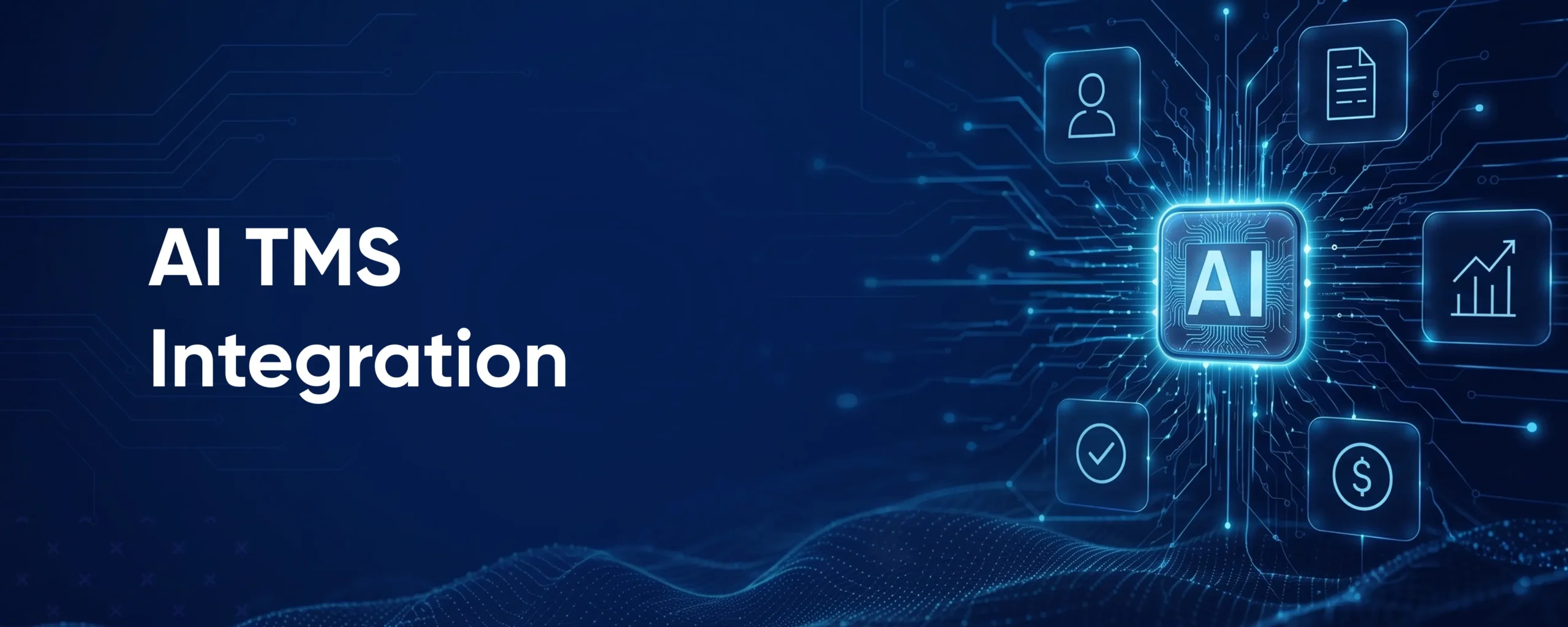
Transportation teams are stuck between two bad options: keep running a transportation management system that can’t keep pace with today’s freight market, or spend a year and a fortune replacing it. There’s a third path. AI TMS integration lets you layer machine learning, predictive analytics, and automation onto the system you already have, without touching the core infrastructure your team depends on every day.
This matters more in 2026 than it did two years ago. Freight volumes are unpredictable, driver and dispatcher talent is scarce, and customers expect delivery updates in real time, not next-day emails. Grand View Research pegs the global TMS market at roughly $21.8 billion in 2026, climbing sharply as AI and cloud-native platforms take over from static, rules-based software.
A recent Inbound Logistics analysis found that AI-augmented routing helped one global carrier cut driving distances by more than 100 million miles a year. That’s not a hypothetical. It’s what happens when you stop treating your TMS as a static filing system and start treating it as a decision engine.
What Is AI TMS Integration?
AI TMS integration is the practice of connecting artificial intelligence — machine learning models, predictive analytics, and automation agents — to your existing transportation management system through APIs, rather than replacing the system outright.
Your TMS still handles the core jobs it always has: load planning, carrier tenders, dispatch, tracking, and settlement. The AI layer sits on top, feeding it live signals and taking routine decisions off your team’s plate. Instead of a planner manually checking traffic, weather, and carrier availability before every load, the AI checks all three continuously and flags only the exceptions that need a human.
Locus describes this shift as moving from a “system of record” to a “system of intelligence” — a TMS that doesn’t just document what happened, but helps decide what happens next. That distinction is the whole point of AI TMS integration: it’s not a new filing cabinet, it’s closer to giving your current system a nervous system it didn’t have before.
Why Legacy TMS Platforms Are Hitting a Wall
Most transportation management systems were built for a world of static rules: fixed lane-carrier mappings, preset routes, and manual exception handling. That model breaks down fast when conditions change daily, and the cracks show up in predictable places across the operation.
Common pain points teams report include:
- Dispatchers spending hours on load board checks and rate calls instead of strategic work
- Customer service teams fielding “where’s my shipment” calls that eat up to 40% of their time
- Freight invoices going unaudited, quietly leaking 3–6% of transportation spend
- Carrier selection based on old rate sheets instead of current performance data
- Exceptions surfacing only after a delivery is already late
- Planners re-configuring rules manually every time a new carrier or lane is added
None of this means your TMS is broken. It means it was never designed to learn from data or act on it in real time. Every network change — a new depot, a new customer promise, a new city restriction — traditionally requires someone to go in and manually update the rules. That’s the specific gap AI TMS integration closes.

How AI TMS Integration Actually Works
The mechanics are simpler than most teams expect, and they don’t require a rebuild. According to CargoFL’s breakdown of AI-powered transportation platforms, the process runs in three stages: data collection from your TMS, WMS, GPS, and carrier APIs; machine learning models that spot patterns in that data; and automation that acts on what the models find.
In practice, that means your existing TMS keeps recording shipments and generating documents exactly as before. The AI layer watches that data stream, predicts which shipments are trending toward a delay, and either alerts a planner or, within approved rules, reroutes the load automatically.
This is what the industry now calls agentic AI: instead of just recommending an action, the system can execute it and only escalate the exceptions that genuinely need human judgment.
| Capability | Traditional TMS Alone | With AI TMS Integration |
| Carrier selection | Static rate sheets | Performance-based, updated continuously |
| ETAs | Set once at dispatch | Recalculated in real time |
| Exception handling | Reactive, after the fact | Predicted before the SLA breaks |
| Freight audit | Manual, spot-checked | Automated anomaly detection |
The result, as TMA Solutions notes in its comparison of AI and traditional TMS, is a shift from a system that stores information to one that acts on it. Nothing about your underlying TMS license, contracts, or trained staff needs to change for this shift to happen.
Core Use Cases Worth Automating First
Not every workflow needs AI on day one. Most successful rollouts start with two or three high-friction areas and expand from there once the first results are proven out.
- Route and load optimization — dynamic re-planning based on live traffic, weather, and delivery windows
- Carrier selection — matching loads to carriers using real performance history, not just contracted rates
- Freight audit and settlement — flagging billing mismatches and duplicate charges before payment
- Proactive exception management — catching a shipment trending toward a missed window early enough to fix it
- Customer communication — automated tracking updates and delivery ETAs via SMS, email, or chat
- Pickup and delivery coordination — confirming appointment windows and rescheduling without phone tag
Isometrik AI’s own logistics workflow automation work shows this pattern clearly: companies that automate customer communication first typically see call volume drop by 60% within the first quarter. That early win builds the internal case — and the budget — for expanding AI TMS integration into route planning and freight audit next.
Real Results: What the Data Shows
The numbers back up the shift. Deloitte’s Global Supply Chain AI research found that shippers using AI-enabled transportation planning saw meaningful gains within 12 to 18 months of rollout. Gartner’s 2025 guidance on AI in supply chain execution adds another layer: AI-based exception management alone can cut manual triage workload by 30–40%.
| Metric | Typical Result |
| Transportation cost per shipment | 8–12% reduction |
| On-time delivery performance | 15–25% improvement |
| Manual exception-handling workload | 30–40% reduction |
| Freight spend recovered via audit | 3–6% of total spend |
One Inbound Logistics case study described a third-party logistics provider that used AI to process transport data and handled 30% more shipment volume with the same headcount. That’s the practical payoff of AI TMS integration: more throughput without proportional hiring, and fewer late-night calls chasing a missed pickup.
Owner-operators see similar gains at a smaller scale. Isometrik’s guide on an AI dispatcher for owner-operators found operators typically save 12 to 20 hours a week once load discovery and rate negotiation are automated. At the enterprise end, Locus’s research points to McKinsey estimates that AI applied to logistics decisions can cut end-to-end costs by 5–20% in asset-heavy supply chains. The scale differs, but the underlying lever — turning idle data into live decisions — is the same.
Build, Buy, or Layer? Choosing Your Approach
Most companies weigh three paths when they decide to modernize. Each comes with real tradeoffs in time, cost, and control.
| Option | Timeline | Best For |
| Build in-house AI tools | 4–9 months | Teams with dedicated developers |
| Replace with new AI-native TMS | 6–12 months | Companies ready for a full migration |
| Layer AI onto existing TMS | 6–8 weeks | Teams wanting fast ROI without disruption |
The third option is why AI TMS integration has become the default choice for most mid-market and enterprise logistics teams, in the US and increasingly across APAC and European networks too. It preserves the TMS your dispatchers already know while solving the specific problems — tracking calls, manual audits, static routing — that are actually costing money every single week.
Getting Started with AI TMS Integration
A successful rollout follows a predictable path, whether you’re a 3PL, a fleet operator, or an e-commerce brand managing your own last-mile delivery.
- Map your current workflows and identify where manual work is creating delays or errors.
- Check your data quality. Clean shipment and carrier records before AI models start learning from them.
- Pick one or two high-impact use cases — customer communication and exception alerts are common starting points.
- Pilot with a subset of routes or customers for two to four weeks before a full rollout.
- Expand gradually, adding new workflows as the first ones prove out.
This is exactly the model Isometrik AI’s logistics-specific agents are built around. Rather than replacing your TMS or WMS, the platform connects directly to systems like McLeod, TMW, Oracle TM, SAP, and Manhattan Associates, layering automated tracking, exception management, and coordination on top of what you’re already running. Deployment typically takes 6 to 8 weeks, and most teams see measurable cost reductions well before the 90-day mark.
Conclusion: AI TMS Integration
AI TMS integration isn’t about tearing down what works. It’s about giving a system built for static rules the ability to learn, predict, and act. Companies that make this shift aren’t necessarily replacing technology — they’re finally putting their existing data to work.
Whether you’re managing a fleet of ten trucks or coordinating freight across a national network, the path forward looks the same: connect the AI layer to your current TMS, start with one or two workflows, and scale once the results speak for themselves.
Ready to see what AI TMS integration looks like for your operation? Explore Isometrik AI’s logistics platform and book a free strategy call to map your first 90 days.