AI Voice Agent for Restaurants: The 24/7 Operator That Never Misses a Call

Restaurants lose an estimated $27,000 every year — not from bad food or slow kitchens, but from unanswered phones. Every missed call during a Friday dinner rush is a missed reservation, a missed order, and a customer who just moved on to the next place on Google.
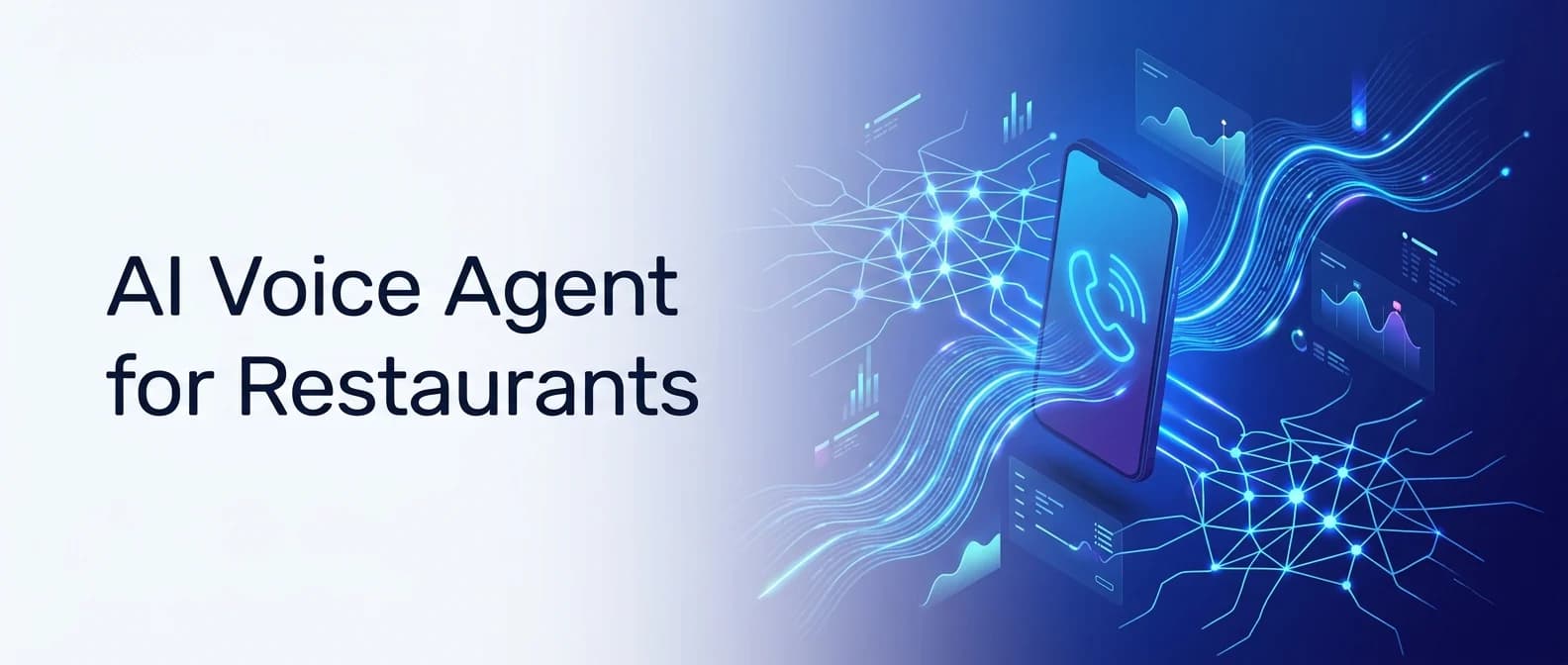
An AI voice agent for restaurants closes that gap by acting as a fully capable, always-on operator that handles calls, books tables, answers questions, and syncs directly with your POS — without a single sick day or salary bump.
This isn’t experimental tech anymore. Voice AI adoption in the restaurant sector has hit 34% in 2025, with accuracy rates at 95% and documented ROI as high as 760% annually. The question isn’t whether it works. It’s whether you can afford to keep running without it.
The Missed Call Problem Is Costing Restaurants Real Money
Most restaurant operators know they miss calls during peak hours. Few realize how much it actually costs them.
Research across hundreds of restaurant locations shows that the average full-service restaurant misses 30–43% of inbound calls during dinner rushes. With an average order value of $45–85 per call, the math gets painful fast. Over two-thirds of Americans say they’ll abandon a restaurant that doesn’t answer — and 85% won’t bother calling back.
Here’s what that looks like in real numbers:
| Monthly Call Volume | Miss Rate (Peak Hours) | Avg. Order Value | Annual Lost Revenue |
| 100 calls/month | 30% | $50 | ~$18,000/year |
| 200 calls/month | 35% | $65 | ~$54,600/year |
| 300 calls/month | 40% | $75 | ~$108,000/year |
These aren’t edge cases. A 60-seat bistro that recovered previously missed calls using voice AI reported over $200,000 in additional annual revenue. AmeriBrunch Cafe in Las Vegas — a real-world deployment — added $3,000 in monthly phone sales while boosting average ticket size by 50%.
The staffing side compounds the problem. Restaurant industry turnover runs at 75% annually. Training a new front-of-house team member to handle phones reliably costs $3,000–$5,000 in recruitment and onboarding alone. Voice AI doesn’t quit, doesn’t need training cycles, and doesn’t put a caller on hold to seat a walk-in.
What an AI Voice Agent for Restaurants Actually Does
A modern AI voice agent for restaurants is not a phone tree. It’s a conversational AI system built to hold natural, two-way conversations — understanding intent, managing context, and completing actions in real time.
When a customer calls in, the agent:
- Greets them in a natural, brand-aligned voice
- Takes full orders including modifications, substitutions, and upsell suggestions
- Checks real-time reservation availability and books or modifies tables
- Answers questions about the menu, allergens, hours, location, and pricing
- Processes secure payments over the phone
- Syncs confirmed orders and bookings directly to your POS and reservation system
- Handles multiple calls simultaneously — zero hold time, zero busy signals
The technology stack behind this involves automatic speech recognition (ASR), large language models (LLMs) for intent understanding, and text-to-speech (TTS) synthesis for natural responses. What that means operationally is simple: the agent sounds like a knowledgeable, patient staff member — at any hour, in any volume.
Understanding what an AI voice assistant does at the infrastructure level helps restaurants set realistic expectations and integrate these tools into existing workflows without friction.
Where Voice AI Makes the Biggest Difference: Key Use Cases
Voice AI creates value across every inbound touchpoint. Here’s how the technology performs against traditional staffing across the most common restaurant scenarios:
| Use Case | Traditional Staff | AI Voice Agent |
| Phone order during dinner rush | Often missed or put on hold | Answered instantly, every time |
| Reservation booking | Manual entry, prone to errors | Auto-syncs with OpenTable or your booking platform |
| FAQ handling (hours, allergies, directions) | Pulls staff away from in-house guests | Handled automatically, 24/7 |
| Drive-thru ordering | Noise, errors, and language barriers | Consistent accuracy in any environment |
| After-hours inquiries | Goes to voicemail; most won’t call back | Captured and converted in real time |
| Upselling | Inconsistent; depends on staff energy | Suggested on every call, every time |
Phone Order Answering is where the immediate ROI shows up. AI agents take complex, customized orders with 95–98% accuracy — outperforming human staff during noisy, high-pressure peak hours. One AI ordering platform reports average ticket sizes 20–40% higher through consistent upsell prompts.
Reservation Management integrates directly with platforms like OpenTable, handling booking requests, waitlist inquiries, modifications, and cancellations without pulling anyone off the floor. No-show rates drop from 12–18% to 4–7% when AI manages confirmation follow-ups.
FAQ Handling frees up your front-of-house team for what actually matters — the guests standing in front of them. Allergen questions, parking information, dress code, catering inquiries — all handled without interrupting service.
Drive-Thru Ordering is where brands like Taco Bell have gone all-in, deploying AI agents across 300+ locations and processing over 2 million orders. The consistency advantage is particularly strong in noisy environments where language barriers or rushed communication cause the most errors.
The ROI Numbers: What Restaurants Are Actually Seeing
The financial case for deploying an AI voice agent for restaurants is well-documented and measurable from day one.
Voice AI systems reduce missed calls by 87% and cut average response time from several minutes to under 15 seconds. Staff time per booking drops from 4.3 minutes to 0.4 minutes. These aren’t projections — they’re reported outcomes from live deployments across US restaurant locations.
| Metric | Before Voice AI | After Voice AI |
| Missed call rate (peak hours) | 30–43% | ~5% |
| Order accuracy | 80–85% | 95–98% |
| Average response time | 3–6 minutes | <15 seconds |
| Staff time per booking | 4.3 minutes | 0.4 minutes |
| Monthly revenue impact | Baseline | +$3,000–$18,000 per location |
| Annual ROI | — | Up to 760% |
The labor math is equally compelling. A dedicated phone staff position in the US costs approximately $45,724 annually including salary, benefits, and turnover overhead. A restaurant-grade AI voice system runs $200–$800 per month. Most operators hit break-even within 6–12 weeks of deployment.
Deepgram’s analysis of the restaurant voice AI market identifies three types of operators accelerating adoption right now: independent restaurants capturing missed revenue, regional chains standardizing the customer experience, and enterprise brands automating every inbound touchpoint at scale.
All three groups share the same driver — a widening gap between what customers expect and what human staffing can reliably deliver.
Top Platforms Powering Voice AI in Restaurants Today
Several specialized platforms have built directly for the restaurant industry, with integrations into the POS and reservation systems already running in most US operations. Evaluating the right AI voice agent platform for your restaurant starts with understanding what each solution is built to do.
- Loman AI: Purpose-built for restaurants. Handles 24/7 inbound calls, processes payments, and connects directly to major POS systems including Toast and Square. Deployment is fast, with minimal setup required.
- VOICEplug AI: Specializes in complex menu handling and intelligent upselling. Routes orders instantly to kitchen display systems, reducing ticket errors and easing front-of-house workload during peak hours.
- SoundHound AI: Covers the full channel stack — phone, drive-thru, and mobile app ordering — in one integrated system. Strong fit for QSR and multi-location operators that need consistency across touchpoints.
- OpenTable Voice AI Partners (Slang AI, PolyAI, Sadie): Vetted integrations that sync natively with OpenTable to capture missed reservation requests, modify bookings, and manage waitlists automatically.
When evaluating any platform, prioritize POS and reservation system compatibility, order accuracy benchmarks, multi-language support, and how the system handles edge cases — complex modifications, accents, or overlapping menu items. Setup time now averages under 60 minutes for most integrations.
How to Roll Out a Voice AI Agent Without Disrupting Operations
Deploying AI voice assistants for business doesn’t require a six-month IT project or a developer on staff. For most restaurant operators, the path from decision to live deployment is shorter than a single hiring cycle.
Here’s a practical rollout approach:
- Audit your current call performance. Track inbound call volume, missed call rate, and average order value for 30 days. This establishes your baseline ROI target.
- Identify your highest-impact use case first. Phone order answering or reservation management — whichever generates the most missed revenue — should go live first.
- Connect to your existing systems. Confirm POS and reservation platform compatibility before selecting a vendor. Most leading platforms integrate with Toast, Square, Aloha, and OpenTable out of the box.
- Configure the agent’s voice and knowledge base. Upload your menu, FAQs, hours, and service rules. The more specific your inputs, the more accurate the agent’s responses.
- Run a pilot during off-peak hours. Test the agent’s handling of real calls before full deployment. Review transcripts and flag edge cases for refinement.
- Go live and monitor weekly. Track missed call rate, order accuracy, average ticket size, and after-hours capture as core KPIs.
For restaurants that want a faster path to production — and a system that extends beyond just voice into full conversational automation across chat, SMS, and in-app — Isometrik’s Conversational AI offers deployment in 12–16 weeks with no-code setup, omni-channel reach, and smart human escalation built in.
It’s built for businesses that want to automate customer engagement across every channel, not just the phone line.
The Bottom Line
Restaurants operate on thin margins. Every missed call, every unanswered reservation inquiry, and every order taken with errors is margin walking out the door. An AI voice agent for restaurants isn’t a future-state technology investment — it’s a revenue recovery tool with a documented payback period measured in weeks, not years.
The operators seeing results aren’t the largest chains. They’re the independent bistros, the regional QSR groups, and the growing multi-location brands that moved early on a technology that is now proven, affordable, and deployable in under an hour.
The businesses still relying entirely on human staff to manage inbound phone volume are leaving between $27,000 and $180,000 in annual revenue on the table — per location.
If your phones aren’t answered during the dinner rush, your competitor’s will be.