Event Based Pricing for Chat SDK: What You Really Pay For

Your chat feature works great in testing. Then a product launch or live event hits, and the invoice triples. Event based pricing for Chat SDK explains why that happens and how to curtail it. Instead of billing per user, vendors charge for activity like messages, receipts, typing indicators, and webhooks.
That model can save you serious money. It can also punish your most engaged users. This guide breaks down how event-based billing works and how it stacks up against MAU and concurrency plans. You’ll also learn how to forecast costs and which guardrails to negotiate before you sign.
What Is Event-Based Pricing for a Chat SDK?
Event-based pricing charges you for each billable action inside your chat. You pay for what users do, not how many users you have. If you’ve seen metered billing in other SaaS tools, the logic is the same.
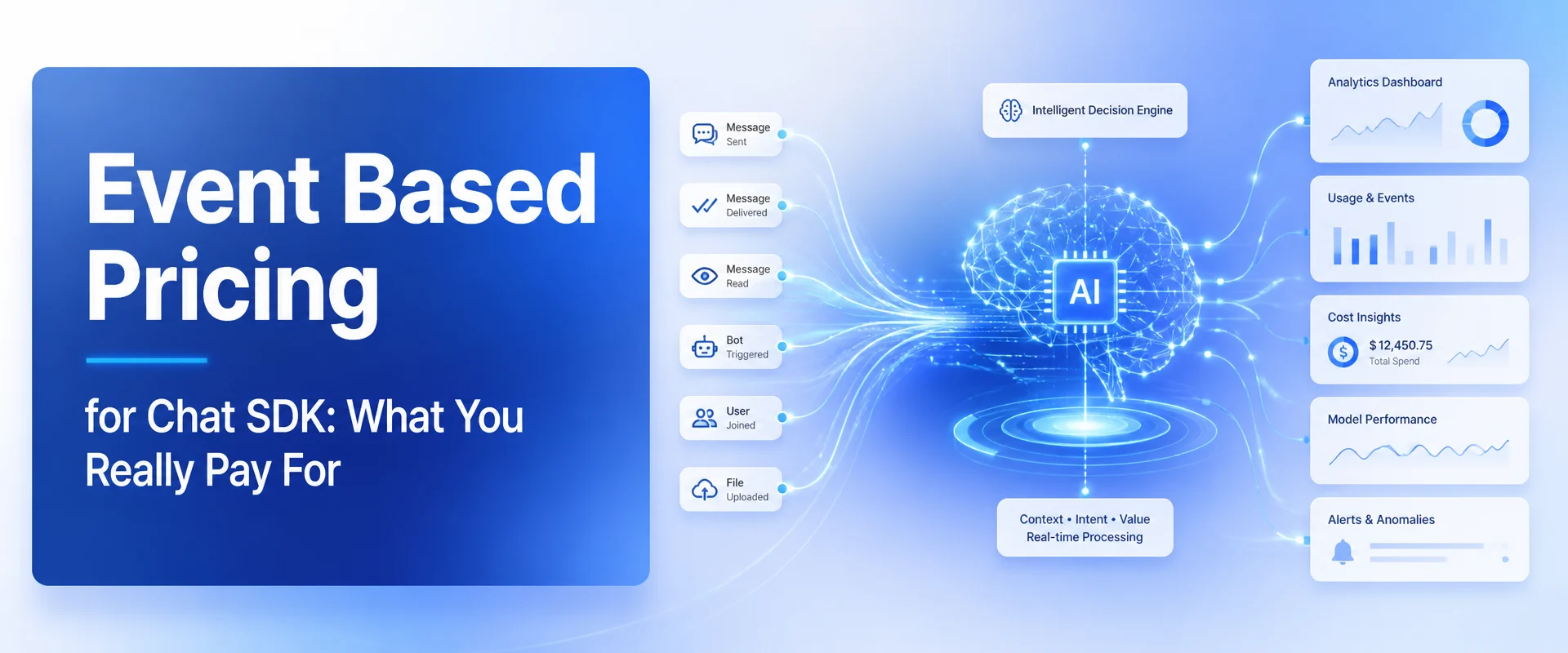
The catch is the word “event.” One visible message can trigger several billable events behind the scenes. Common billable events include:
- Messages sent to the server
- Messages delivered to each recipient
- Read and delivery receipts
- Typing indicators
- Reactions and emoji
- Presence updates, such as online, offline, or away
- Webhook calls to your backend
Vendors define events differently. Some count only messages, while others also meter connection minutes. Always get the exact list of billable events in writing.
Chat SDK Pricing Models Compared: MAU vs. Concurrency vs. Events
Most chat vendors fall into three camps. Each model rewards a different traffic pattern. Picking the wrong one is the fastest way to overpay.
| Pricing model | What you pay for | Best fit | Main risk |
| Monthly active users (MAU) | Unique users who connect in a 30-day window | Steady daily chat, like marketplaces or SaaS workspaces | Paying for users who barely chat; hidden concurrency caps per tier |
| Concurrent connections | Users online at the same moment | Live events with predictable peaks | Hard caps can block users during surges |
| Event-based (pay-per-event) | Messages, receipts, presence, webhooks, connection minutes | Spiky or seasonal traffic, pilots, low-volume apps | No natural ceiling; fan-out multiplies events fast |
MAU pricing is the default for many large chat SDK vendors. Many MAU tiers also cap peak concurrent connections, so check both numbers. This breakdown of chat SDK pricing models shows how concurrency limits change the math.
Hybrid plans are becoming more common. Some vendors pair a base fee with metered overages. Others let you choose between MAU and usage billing.
Which Chat Events Really Drive Your Bill
Fan-out is the cost driver most teams miss. When one user posts in a group, the message goes to every member. Many vendors count each delivery as a separate billable message.
Ably’s own livestream pricing example makes this concrete. Picture 5,000 viewers who each send five messages and two reactions. That’s only 35,000 messages sent. Delivered to every viewer, it becomes about 175 million billable messages.
With server-side batching, the same event drops to roughly 36 million messages. Presence is another quiet budget killer. Ably notes that 200 members joining and leaving a channel can generate about 80,400 messages. That’s before anyone types a word.
| Event type | How often it fires | Cost impact | How to control it |
| Group message delivery | Once per recipient, per message | Very high in large rooms | Batch deliveries; cap room size |
| Typing indicators | Every few seconds while typing | High in active chats | Throttle, or disable in big groups |
| Read receipts | Once per reader, per message | High in groups | Limit to 1:1 and small groups |
| Presence updates | Every join, leave, or status change | Spikes during events | Show occupancy counts instead |
| Reactions | Per tap, per recipient | High in live streams | Aggregate counts on the server |
| Webhooks | Per backend notification | Moderate | Subscribe only to events you use |
| Idle connections | Per minute while connected | Low per user, adds up at scale | Drop inactive or backgrounded sessions |
The takeaway is simple. Your bill tracks how many people receive each event, not how many send it.
When Event Based Pricing for Chat SDK Makes Sense (and When It Backfires)
Event-based billing shines when usage is low or uneven. It hurts when engagement is high and constant. Here’s how that plays out across industries.
It often works well for:
- Telehealth apps, where patients message providers a few times per visit
- Legal client portals, with low-volume, document-heavy conversations
- Recruitment platforms, where candidate chats spike around hiring cycles
- Logistics apps, where drivers and dispatchers trade short status updates
- Pilots and MVPs, where you don’t want to commit to a big MAU tier
It can backfire for:
- Live commerce and streaming, where chat and reactions fan out to thousands
- Online classrooms, where typing and presence fire all session long
- Community apps with large, always-on group channels
- Dating and social apps, where heavy messaging is the core product
The rule of thumb is easy to remember. Small rooms and occasional chats favor pay-per-event plans. Large rooms and chatty features call for MAU, concurrency, or a capped hybrid.
How to Forecast Chat SDK Costs Before You Sign
You don’t need perfect data to build a forecast. You need honest assumptions and a simple spreadsheet. Follow these steps:
- Estimate monthly active users and peak concurrent users.
- Estimate messages sent per active user each month.
- Multiply by average recipients per message to get deliveries.
- Add receipts, typing, presence, and reactions as multipliers.
- Model a normal month and your biggest expected spike.
- Price both scenarios against each vendor’s real rate card.
The table below compares two common traffic shapes. Figures are illustrative, not vendor quotes.
| Factor | Scenario A: Support-style chat | Scenario B: Live event chat |
| Users | 50,000 MAU, about 200 online at once | 10,000 viewers online for two hours |
| Typical room size | 2 people (1:1) | 10,000 people in one room |
| Messages sent | 20 per user per month (1 million total) | 3 messages plus 2 reactions per viewer (50,000 total) |
| Deliveries before batching | About 1 million | About 500 million |
| Safer pricing model | Event-based or usage-based | MAU, concurrency, or event-based with batching |
| Biggest risk | Paying for idle users on an MAU plan | Fan-out multiplying a pay-per-event bill |
Notice the gap. Scenario B sends 20 times fewer messages but creates 500 times more deliveries. Room size, not user count, drives event-based costs.
Hidden Costs and Guardrails to Negotiate
The rate card is only half the story. Add-ons and overage terms often decide what you actually pay. Watch for these line items:
- Overage rates that run higher than base rates
- Separate fees for push notifications or moderation
- Charges for message history and storage retention
- Extra pricing for voice, video, or AI features
- Peak concurrency caps buried inside MAU tiers
- Minimum monthly commitments on usage plans
- Usage rounded up to large billing increments
Next, lock in guardrails before you scale. Ask for spending caps, usage alerts, and a prepaid option. Prepaid credits turn an open-ended bill into a budget you control.
It’s also worth revisiting the bigger picture. Fora Soft’s look at chat API economics explains why buying usually beats building real-time messaging. If you’re still on the fence, our build vs. buy decision guide walks through the trade-offs.
How Isometrik Keeps Chat Costs Predictable
Isometrik is built for teams that want flexibility without surprise invoices. The Isometrik Chat SDK supports unlimited concurrent connections, messages, and users. A viral moment won’t slam into a hard connection cap.
Billing runs on prepaid plans. If you go past your plan, overages come out of a prepaid wallet. They’re never charged directly to your credit card.
Here’s what comes with the SDK:
- 1:1, group, broadcast, and live chat
- Read receipts, delivery receipts, reactions, and mentions
- Push notifications for new messages and mentions
- An analytics and moderation panel with role-based permissions
- Webhooks that connect chat to your backend systems
- Open-source UI kits for iOS, Android, and Web
- SOC 2 and HIPAA compliance for regulated industries
Running live events or shoppable streams? Pair chat with Isometrik’s live streaming SDK for in-stream chat overlays. Still comparing vendors? Our roundup of alternatives to CometChat covers more options side by side.
Final Thoughts
Event based pricing for Chat SDK can be the smartest deal on the table. It can also be the most expensive one. The difference comes down to room size, chatty features, and the guardrails you negotiate.
Model your normal month and your biggest spike. Compare at least two pricing models side by side. Then choose a partner that keeps costs predictable as you grow. Talk to the Isometrik team to see how prepaid chat pricing fits your roadmap.