How a Multiagent AI System for Sales and Marketing Sets Your Revenue Racing

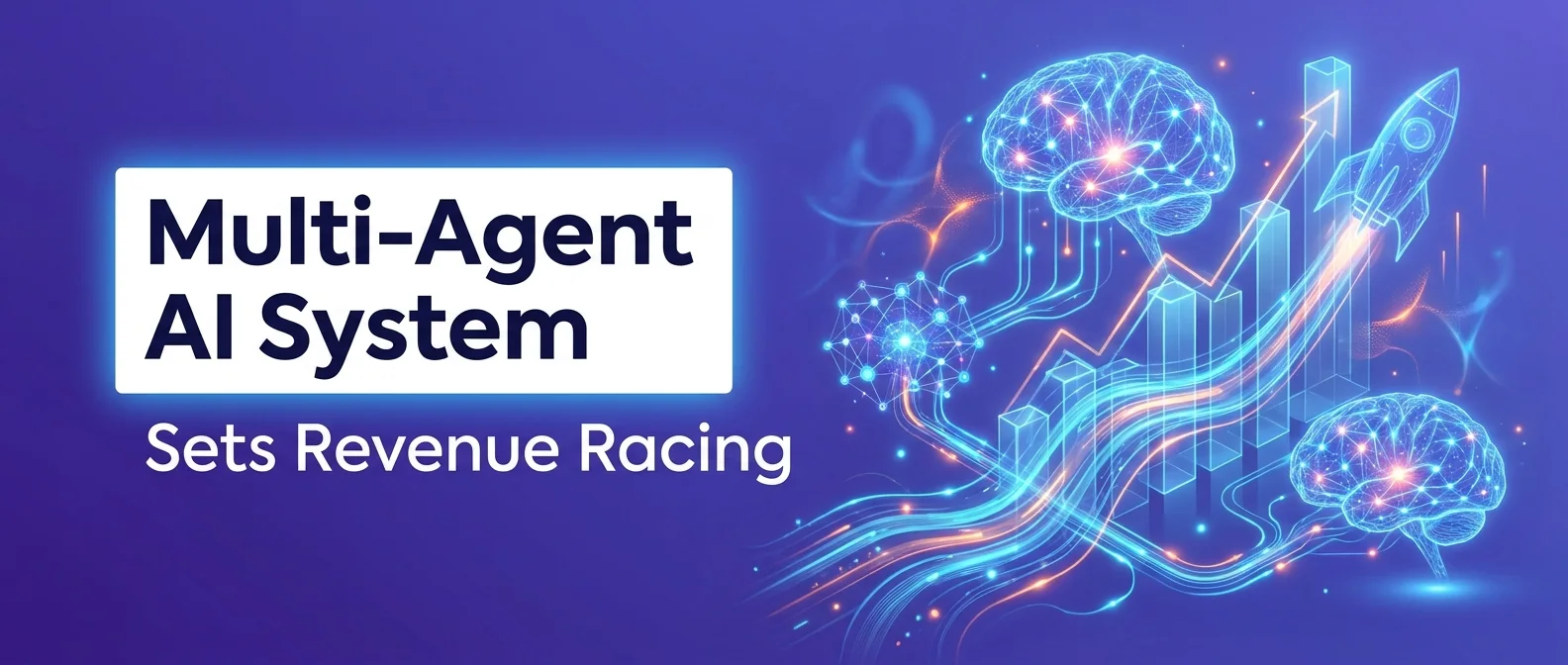
Most businesses treat AI like a single hire — one tool, one lane, one task. That thinking is already costing them. A multiagent AI system for sales and marketing changes the equation entirely. Instead of one AI node doing everything, you get a coordinated crew of specialized agents. Each owns a defined role and works your pipeline 24/7 without bottlenecks.
Gartner projects that 75% of large enterprises will adopt multi-agent systems by 2026. The AI agent market is growing at a 46.3% CAGR — from $7.84 billion in 2025 to $52.62 billion by 2030. The companies pulling ahead aren’t just testing AI. They’re building coordinated systems that compound results across every stage of the revenue funnel.
What Is a Multiagent AI System — And Why One AI Agent Falls Short
A single AI agent is a standalone node. It takes input, processes it, and returns output. In a sales context, that means one AI juggling prospect research, email writing, lead qualification, copy review, and campaign delivery. All by itself. Quality suffers. Speed drops. Results are inconsistent.
A multiagent AI system is fundamentally different. It’s a network of autonomous AI agents, each built for one specific job. A central orchestrator manages sequencing, context, and handoffs between them. Think of it like a real department: a researcher, a copywriter, a qualifier, and a campaign manager. All of them report to a supervisor who decides who acts next.
IBM defines multiagent systems as architectures where multiple AI entities communicate, collaborate, and coordinate to accomplish goals no single agent can manage alone. Google Cloud reinforces this: the power comes from specialization and parallel execution — not centralization.
The value isn’t just speed. It’s role clarity and compound output at scale — across every touchpoint your pipeline depends on.
How a Multiagent AI System for Sales and Marketing Teams Work
Every effective multi-agent setup operates on two layers: an orchestrator and worker agents.
The orchestrator acts as the supervisor node. It receives the task, decides which agent fires first, passes specific instructions, reviews outputs, and triggers the next worker. It controls the flow — it doesn’t do the work.
The worker agents each own a defined function. Here’s how a typical multi-agent AI system maps to a sales and marketing team:
| Agent Role | Core Function |
| Research Agent | Pulls prospect data, company signals, and buying intent |
| Outreach Agent | Drafts personalized emails, sequences, and social messages |
| Content Agent | Creates campaign copy, landing pages, and blog assets |
| Qualification Agent | Scores leads and filters pipeline based on fit criteria |
| Review Agent | Checks output for accuracy, tone, and brand compliance |
| Campaign Output Agent | Finalizes deliverables and routes them for execution |
These agents don’t just fire sequentially. They loop back to the orchestrator after each task — reporting results and receiving updated instructions. This directly mirrors how a real team moves work forward.
Salesforce frames this as a shift from isolated AI tools to coordinated agent ecosystems. Governance and integration determine ROI — not raw AI capability alone.
Key Use Cases Where the Multi-Agent AI System for Sales and Marketing Pays Off
Multi-agent AI systems generate the highest returns in workflows that are high-volume, repetitive, and multi-step. Here’s where they’re already driving results:
- Prospect research and enrichment — Agents pull firmographic data, flag decision-makers, and score accounts in seconds. Research that used to consume SDRs 15–20 hours per week now takes minutes.
- Personalized outreach at scale — Outreach agents craft messages using real buying signals: recent funding rounds, LinkedIn activity, and job changes. No more first-name-only templates.
- Instant lead qualification — Qualification agents run 24/7, engaging inbound leads immediately. Only high-fit prospects get routed to your reps.
- Campaign creation and distribution — Content agents produce SEO-optimized posts, ad copy, and landing pages. The orchestrator maintains brand consistency throughout.
- CRM updates and pipeline visibility — Agents log interactions, update contact records, and surface stale deals automatically. No rep input required.
- Multi-touch follow-up sequences — Outreach agents manage follow-ups, adjusting timing and messaging based on open rates and reply patterns.
The numbers back this up. Multi-agent setups report 7x higher conversion rates. AI-driven outreach consistently hits 25% response rates — compared to the 5–10% typical of human SDR teams.
Explore AI agent use cases that go beyond theory into production-ready applications across industries.
Multi-Agent AI System vs. Single Agent: The Performance Gap
Deploying one AI agent across your entire pipeline is like hiring a single generalist to replace a full department. Here’s what the performance gap looks like in practice:
| Metric | Single AI Agent | Multi-Agent AI System |
| Lead response time | Delayed — sequential processing | Near-instant — parallel execution |
| Outreach personalization | Generic or templated | Signal-driven and context-aware |
| Research time reduction | 30–40% | 80–90% |
| Email response rates | 5–12% | Up to 25% |
| Revenue impact | Marginal | 25–35% increase reported |
| Pipeline conversion lift | Modest improvement | 7x higher in multi-agent setups |
| Scalability | Capped by single-agent throughput | Scales without adding headcount |
The bottom line: a multi-agent system doesn’t just work faster. Each agent is optimized for one outcome — not stretched thin across many functions. The architecture itself becomes the competitive advantage.
Before committing to a framework, understand the full scope of what it takes to build and deploy AI agents at an enterprise level — from data foundations to integration requirements.
How to Build a Multi-Agent AI System for Your Sales and Marketing Stack
Getting started doesn’t require a dedicated engineering team or months of development. Here’s a practical approach:
- Start with the bottleneck, not the vision. Identify your most painful, high-volume workflow gap — slow lead response, poor outreach personalization, or stalled follow-up sequences.
- Map every manual step. Trace the process from lead discovery to closed deal. Each manual step is a candidate for an agent role — don’t automate before you understand what you’re replacing.
- Choose your orchestration layer. The supervisor node controls agent handoffs, sequencing, and context passing. Isometrik’s Agent Studio lets you build multi-agent workflows visually — no code, 100+ templates, and full API integrations included.
- Assign specific data sources per agent. Your research agent needs CRM access and intent signals. Your outreach agent needs approved messaging frameworks and brand voice guides.
- Build in human review checkpoints. Place human judgment between the review agent and final campaign output. Don’t automate decisions that carry significant brand or revenue risk.
- Measure what actually moves the needle. Track meetings booked, lead-to-meeting conversion rate, and pipeline velocity — not just emails sent or content pieces published.
Review the full picture of AI for sales automation before you lock in a deployment model — especially around where the highest ROI typically materializes first.
Common Mistakes That Sink Multi-Agent AI Deployments
Multi-agent AI systems underperform when built as disconnected point solutions. These are tools that don’t talk to each other or your existing stack. These are the mistakes most often derailing real-world deployments:
- No CRM integration — Agents producing outputs that never sync to your pipeline create silos, not scale. Every agent output should write back to your source of truth.
- Vague system prompts — Each agent needs precise role definitions and scope boundaries. Ambiguous instructions produce generic, unusable outputs every time.
- Scaling before validating — More agents don’t equal better results. Start lean, confirm each role delivers clean output, then expand.
- Measuring activity over outcomes — Emails sent and posts published are vanity metrics. Measure pipeline generated, conversion rates, and revenue impact.
- No feedback loops — Agent outputs should continuously refine the system’s performance. Without learning cycles built in, performance plateaus within weeks.
CleverTap highlights that role clarity, handoff logic, and governance must be locked in before deployment begins. Retrofitting them later is where most implementations run into trouble.
Why Isometrik AI Is the Right Starting Point for Your Multi-Agent Build
A multi-agent AI system for sales and marketing is only as strong as the platform powering it. Isometrik AI offers production-ready solutions built for revenue teams. No generic AI wrappers, no months of configuration before they’re useful.
Here’s how Isometrik’s core offerings map directly to the agent roles your team needs:
| Agent Role | Isometrik Solution | What It Does |
| Outreach & Engagement Agent | AI SDR Team | Prospect research, personalized campaigns, multi-inbox delivery, and complete follow-up sequences |
| Content & Campaign Agent | AI Marketing Automation | SEO blog posts, landing pages, ad copy, and omnichannel campaign execution from ideation to distribution |
| Workflow Orchestration | Agent Studio | No-code, drag-and-drop multi-agent builder with 100+ templates, API integrations, and enterprise-grade security |
Deployment timelines are significantly compressed. Pre-built agents go live in 6–8 weeks. Custom multi-agent workflows through Agent Studio are production-ready in 12 weeks. No need to replace your existing tech stack or bring in an internal dev team.
The cost gap is hard to ignore. Hiring human SDRs runs $80,000–$120,000 per year in total compensation. AI SDR agent subscriptions cost a fraction of that — with ROI typically realized within 90 days of deployment.
Explore what AI SDR agents look like inside a fully coordinated, multi-agent sales system built for real revenue outcomes — not just activity metrics.
The businesses winning right now aren’t using more AI tools. They’re using better-coordinated ones.