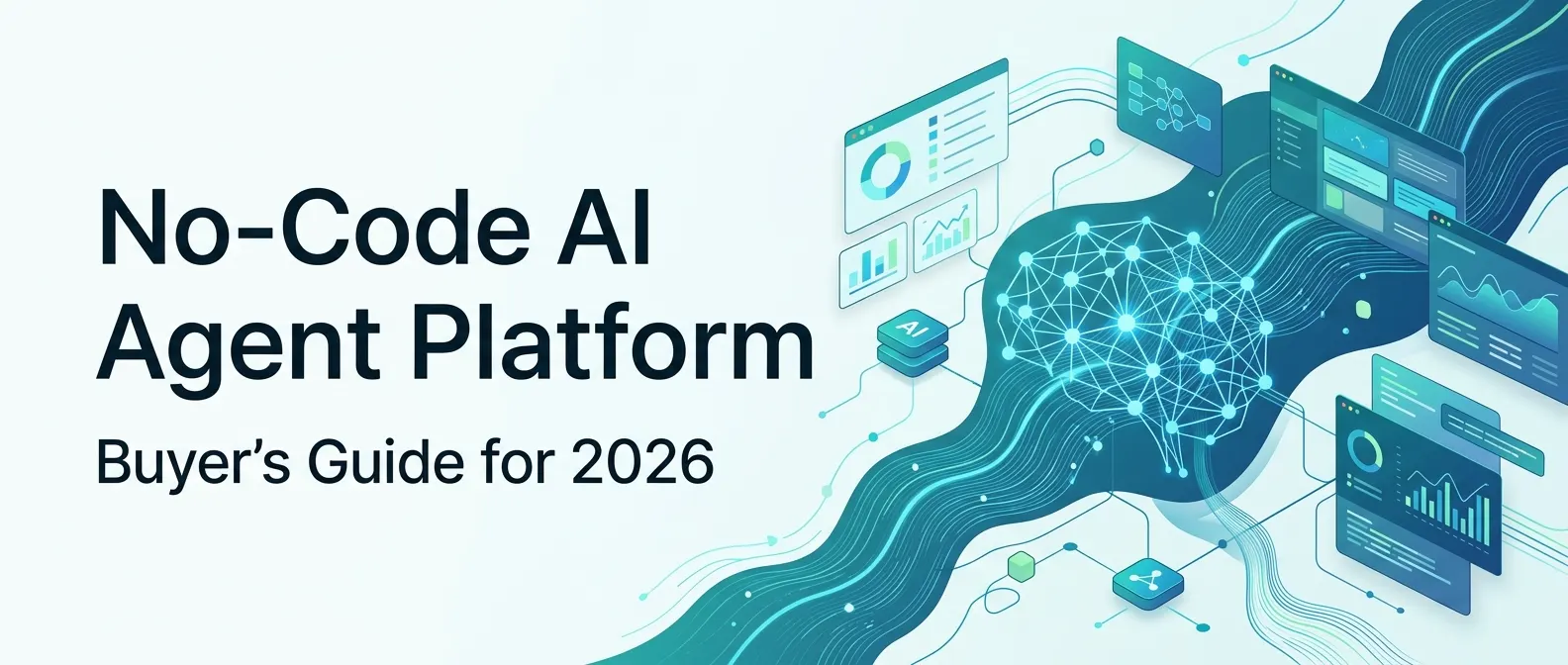
No-Code AI Agent Platform: A Buyer’s Guide for 2026

The conversation around AI has shifted — fast. It’s no longer about whether to adopt AI. It’s about how quickly your business can put it to work. A no-code AI agent platform promises to close that gap without a dev team, without months of build cycles, and without six-figure engineering contracts.
But here’s the reality: not every platform delivers on that promise. Some require code the moment you try to go live. Others are chatbot builders wearing agent-sounding labels. And several demand so much platform-specific learning that “no-code” feels like a marketing line, not a real capability.
This blog talks about what genuine agent platforms actually do, what separates the real ones from the pretenders, and what to evaluate before committing.
What a No-Code AI Agent Platform Actually Does
A no-code AI agent platform lets businesses design, train, and deploy intelligent agents without writing a single line of code. These agents don’t just respond to inputs. They reason, plan, execute multi-step actions, and loop back based on results.
The critical distinction: this is not a chatbot builder. Chatbots follow scripts. AI agents follow goals. A well-built agent can pull data from your CRM, compose a follow-up message, update a record, and escalate to a human — all in one automated workflow, triggered without anyone clicking a button.
Genuine platforms combine these core capabilities:
• A visual drag-and-drop builder for designing workflows without code
• Native LLM integration — AI reasoning built into the platform itself
• Tool connectivity — prebuilt connectors to CRMs, ERPs, and communication tools
• Memory and context — agents that retain information across sessions
• Human-in-the-loop controls — approval gates built in, no coding required
Why Businesses Are Racing Toward No-Code AI Agent Platforms
The global no-code AI platform market was valued at $9.01 billion in 2026 and is projected to reach $23.82 billion by 2030, growing at a 27.5% CAGR. Meanwhile, 72% of enterprises plan to deploy AI agents from trusted vendors in 2026.
What’s driving this surge? Several converging forces:
• The AI engineering talent gap is real, costly, and widening
• Business teams want automation without waiting in the IT backlog
• AI models are now mature enough to handle production workloads
• The cost of not automating is measurable in lost revenue and hours
By 2026, 80% of no-code platform users will sit outside IT departments entirely. Sales, ops, HR, and customer success teams are building the automation they need on their own timelines. The demand is no longer coming from developers — it’s coming from operators and founders who understand the workflow but lack the coding background to build it.
Who is adopting AI agent platforms and why
| Business Type | Primary Driver | Most Common Use Case |
| Startups | Speed to market | Customer support, lead qualification |
| SMBs | Cost reduction | Scheduling, follow-ups, data entry |
| Enterprises | Scale and consistency | Cross-department workflow automation |
| SaaS Companies | Product differentiation | In-app AI assistants, onboarding agents |
What Separates a Legitimate No-Code AI Agent Platform From the Rest
This is where most buyers go wrong. A tool can look fully no-code in a demo and reveal itself as code-dependent the moment you try to deploy it or connect it to a real business system.
Here’s the checklist to apply before committing:
• True visual deployment — Can you push to production without touching a terminal?
• Native AI integration — Is a language model built in, or must you supply your own API key?
• Out-of-the-box connectivity — Does it connect natively to your CRM, ERP, or helpdesk?
• Multi-step agent logic — Can agents make decisions, not just answer questions?
• Memory across sessions — Does the agent retain context from prior interactions?
• Enterprise compliance — SOC2, HIPAA, GDPR where your industry requires it
• Scalable infrastructure — Will it hold up at 10,000 interactions as well as at 10?
No legitimate no-code AI agent platform should force you to write Python to handle an edge case. That makes it low-code at best — and for non-technical teams, that distinction kills adoption.
Feature checklist for evaluating AI agent builders
| Feature | Priority Level | Red Flag if Absent |
| Visual drag-and-drop builder | Must-have | Yes |
| Native AI model (no external key required) | Must-have | Yes |
| Pre-built tool integrations (CRM, ERP, etc.) | Must-have | Yes |
| Cross-session memory and context | Must-have | Yes |
| Human-in-the-loop approval controls | High | No |
| Custom API support | High | No |
| Compliance certifications (SOC2, HIPAA, GDPR) | Enterprise-critical | Yes |
Industries Seeing the Strongest ROI From No-Code AI Agents
The business case isn’t theoretical. Across sectors, companies are cutting overhead, compressing timelines, and improving output quality — without adding headcount.
AI agent use cases and outcomes by industry
| Industry | Agent Use Case | Business Outcome |
| E-commerce | Returns handling, upsell recommendations | Up to 40% fewer support tickets |
| Legal | Contract intake, deadline tracking | Research time cut from days to hours |
| Healthcare | Appointment scheduling, follow-up reminders | 30%+ reduction in admin workload |
| SaaS | User onboarding, churn detection | Faster activation, reduced churn |
| Logistics | Shipment exceptions, carrier coordination | Fewer manual escalations |
| HR / Recruitment | Candidate screening, interview scheduling | Up to 10x recruiter capacity increase |
What “No-Code” Often Hides — And What to Watch For
The “no-code” label is one of the most overused terms in the AI space. Here are the five traps businesses consistently fall into:
Deployment requires code.
Many tools look visual in the builder but break down the moment you push to production or connect a custom API endpoint.
It’s a GPT wrapper, not an agent.
Some platforms let you write a system prompt and call it an agent. A genuinely agentic builder enables multi-step, tool-using, memory-aware automation — not just smarter chat.
The learning curve is just a different kind of steep.
Replacing code with proprietary platform logic — its own triggers, node types, and rule sets — still takes weeks to master. That’s platform-specific complexity, not genuine no-code.
No native AI included.
If you need to supply your own API key for basic functions, you have a framework, not a finished solution. For non-technical teams, that’s a showstopper.
It can’t scale beyond the pilot.
Proof-of-concept agents often work cleanly. Production agents handling thousands of daily interactions and branching decisions regularly break platforms not built for enterprise load.
Knowing these traps in advance saves months of wasted effort — and real budget.
How Isometrik’s Agent Studio Delivers on the No-Code Promise
Most tools in this space put the burden on your team. Isometrik’s Agent Studio flips that model — dedicated AI specialists do the building, so your team doesn’t have to.
This is a managed service, not just a platform. Isometrik’s AI specialists design your agent architecture from scratch, train agents on your business data, connect your tools and APIs, and deploy production-ready workflows — typically within 12 to 16 weeks. No platform learning curve. No half-finished agents stalling in a sandbox. No surprise code requirements at go-live.
Agent Studio runs on a no-code visual canvas with modular, reusable components. Agents clone across departments, update fast, and scale without a full rebuild. Enterprise compliance — SOC2, HIPAA, GDPR — is built in by default.
The outcomes across client deployments are consistent: 300%+ increases in user engagement, 10x recruiter capacity expansions, 80% improvements in service discovery — all within 12-week deployment windows. For businesses in e-commerce, legal, healthcare, SaaS, logistics, or HR, Agent Studio delivers full-stack agent deployment with specialists managing every step.
Conclusion
Choosing the right no-code AI agent platform comes down to one honest question: does it hold up when you leave the demo? That means native AI, true deployment, production-scale reliability, and integration with your actual tech stack.
The market is moving fast. The segment is projected to nearly triple in value by 2030. Businesses that commit to the right platform now will outpace those still evaluating in 18 months. With Isometrik’s Agent Studio, you get the specialists, the infrastructure, and production-ready delivery — no trial-and-error required.