Why AI Deployment in 6 Weeks is Achievable and Essential

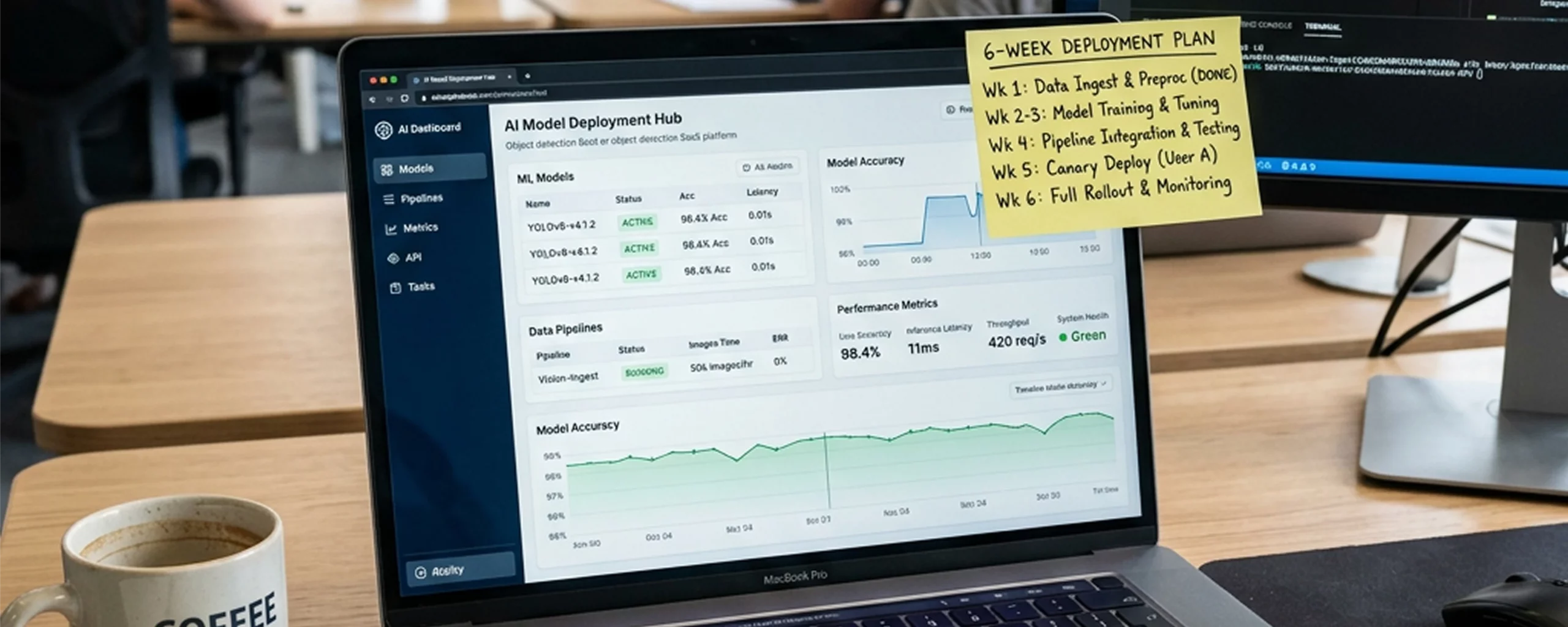
In today’s fast-paced US market, mid-market businesses with 50-5,000 employees face mounting pressure to automate manual tasks in sales, recruitment, and operations. Yet, many AI initiatives stall, taking 6-18 months from idea to production. AI deployment in 6 weeks changes that. It targets production-ready systems that deliver immediate value, like AI agents handling lead research or candidate matching.
This speed matters because delays mean lost revenue. For instance, sales teams lose 20-30% of deals due to slow follow-ups, while recruitment delays cost firms $4,000 per hire in lost productivity. Fast deployment lets you integrate AI with CRMs like Salesforce or ATS platforms like Lever, reducing costs by 15-25% without heavy IT involvement.
Businesses achieve this by leveraging modular AI platforms. These pre-built tools, customized for your workflows, bypass lengthy coding phases. Result: Quicker ROI, with 38% of early adopters seeing gains in under three months, according to Deloitte.
Overcoming Common Challenges in Traditional AI Rollouts
Traditional AI projects falter on complexity.
One hurdle: Overambitious scopes. Starting with enterprise-wide AI leads to scope creep, where pilots balloon into year-long epics. Another: Vendor lock-in. Custom builds tie you to developers, hiking costs 2-3x.
Security concerns loom large, especially in regulated sectors like banking or healthcare. Without compliant frameworks, deployments halt for audits. Finally, team resistance. Ops leaders worry AI will replace jobs, slowing adoption.
To counter these, narrow focus. Target one function, like sales prospecting, where AI can qualify leads 50% faster. Use platforms with built-in compliance, such as SOC 2 standards, to ease legal reviews.
A Midwest SMB in e-commerce faced data fragmentation across Shopify and QuickBooks. Their traditional approach stalled at 4 months. Switching to a phased, agent-based strategy resolved it in weeks, proving preparation trumps perfection.
| Challenge | Traditional Impact | 6-Week Solution |
| Data Silos | 3-6 month delays | Pre-integrate with APIs for CRM/ERP |
| Skill Gaps | High training costs ($50k+) | Partner with experts for turnkey setup |
| Scope Creep | Budget overruns (20-40%) | Pilot one use case, scale later |
| Security | Audit halts (2-4 weeks) | Use compliant platforms from day one |
Step-by-Step Strategy for AI Deployment in 6 Weeks
AI deployment in 6 weeks demands a structured plan. Draw from Stanford’s framework: Define problems, time strategically, plan execution, and measure benefits. Here’s how, tailored for sales, recruitment, or ops leaders.
Week 1: Assess and Prioritize. Audit current workflows. Identify pain points, like SDRs spending 60% of time on manual research. Map to AI agents — chatbots for customer queries or voice bots for scheduling. Gather stakeholder buy-in from CTOs and ops heads.
Week 2: Select Tools and Partners. Evaluate build vs. buy (more below). Opt for platforms offering conversational AI and multi-agent systems. Ensure US-based support for quick iterations. Budget: $5k-50k for pilots, scaling to $100k+ for full rollout.
Weeks 3-4: Build and Integrate. Customize agents for your stack. For recruitment, integrate with ATS to screen resumes automatically. Test data flows — aim for 90% accuracy. Use agile sprints: Daily check-ins keep momentum.
Weeks 5-6: Test, Launch, and Optimize. Run user pilots with real data. Measure against KPIs like response time (target: 50% reduction). Launch with training sessions. Monitor for issues, tweaking via dashboards.
This timeline aligns with 360 Automation’s benchmarks, where standard bots deploy in 2-8 weeks. A California SaaS firm used it for sales AI, cutting lead response from days to hours.
- Start small for quick wins; involve end-users early; track progress weekly.
- A banking ops team automated ticket routing, handling 30% more volume without hires.
Success hinges on cross-functional teams. CTOs ensure tech fit; sales heads validate ROI.
Build vs. Buy: Making the Right Decision for Speed
The build vs. buy debate defines deployment speed. Building custom AI from scratch suits unique needs but takes 6-12 months and $200k+, per industry averages. It’s ideal for proprietary IP but risks overruns.
Buying pre-built agents flips this. Platforms like those from Isometrik offer customizable bots for $5k-300k, deploying in weeks. They integrate seamlessly with CRMs, reducing dev time by 70%.
| Aspect | Build In-House | Buy Platform |
| Timeline | 6-18 months | 4-8 weeks |
| Cost | $100k-500k+ | $5k-100k initial |
| Flexibility | High customization | Modular, scalable |
| Expertise Needed | Internal AI team | Minimal; partner-led |
| ROI Speed | Slow (post-launch) | Immediate pilots |
For mid-market US firms, buy wins for urgency. A legal services provider bought an AI workflow tool, automating contract reviews 40% faster than building. Drawback: Less uniqueness, but updates keep it current.
Hybrid approaches blend both: Buy core agents, build light customizations. This balances speed and control, achieving 6-week goals.
Real-World Examples: AI in Sales, Recruitment, and Operations
Fast AI shines in targeted applications. In sales, AI agents personalize outreach, boosting reply rates 25-40%, per Gong data. A New York growth firm deployed lead-gen bots in 5 weeks, integrating with HubSpot. Result: 30% more qualified leads, ROI in 2 months.
Recruitment benefits from screening automation. Manual resume reviews take 23 hours per hire; AI cuts it to 5. A Chicago healthcare recruiter used ATS-integrated agents, shortening time-to-hire by 45%. Deployment: 6 weeks, with 20% cost savings.
Operations see workflow gains. In logistics, AI handles inventory queries, reducing errors 35%. A Florida e-commerce ops leader launched multi-agent systems in 6 weeks via ERP ties, managing 50% higher volumes without extra staff.
These cases, inspired by Google Cloud benchmarks, show 10-20% sales ROI lifts. The key: Tie AI to revenue, like faster pipelines.
- Sales: AI scores leads
- Recruitment: Matches skills
- Operations: Predicts delays
| Function | Use Case | Efficiency Gain | Deployment Time |
| Sales | Lead qualification | 30% faster pipeline | 5 weeks |
| Recruitment | Resume screening | 45% shorter cycles | 6 weeks |
| Operations | Ticket routing | 35% volume increase | 4 weeks |
Calculating ROI and Timelines for Your AI Investment
ROI from AI deployment in 6 weeks averages 200-300% over 12 months, per McKinsey. Calculate via: (Gains – Costs) / Costs. Gains: Time saved (e.g., 4,000 sales hours/month, valued at $50/hour = $200k savings). Costs: $20k setup + $10k/month ops.
Timelines: POC in 4 weeks, full in 6-8. Benchmarks show 15% of firms hit significant ROI fast via agents.
For a $10M revenue firm, sales AI might add $500k in deals. Risks: 10-20% initial overestimation; mitigate with pilots.
Track KPIs: Cost per lead (down 20%), hire speed (up 40%), support resolution (95% automated).
Conservative ranges: 10-30% efficiency, breakeven in 3-6 months. A banking example: $150k investment yielded $450k savings in ops.
Next Steps for Your AI Journey
AI deployment in 6 weeks isn’t hype — it’s executable with the right focus. Start by auditing workflows and piloting one agent. This positions your business for scalable growth.
Platforms like Isometrik AI help organizations deploy production-ready AI agents without long development cycles, ensuring secure, owned systems that drive real outcomes.