AI Voice Agent vs IVR: Which One Should You Actually Build?

Your phone system is quietly deciding how much revenue you keep or lose every single day. That’s the real stakes behind the AI Voice Agent vs IVR decision, and it’s not just a tech upgrade question. One system routes calls with buttons. The other holds a real conversation and gets things done.
Picking the wrong one for your business size, budget, and risk tolerance is an expensive mistake, so let’s break down exactly how to choose.
AI Voice Agent vs IVR: The Core Difference
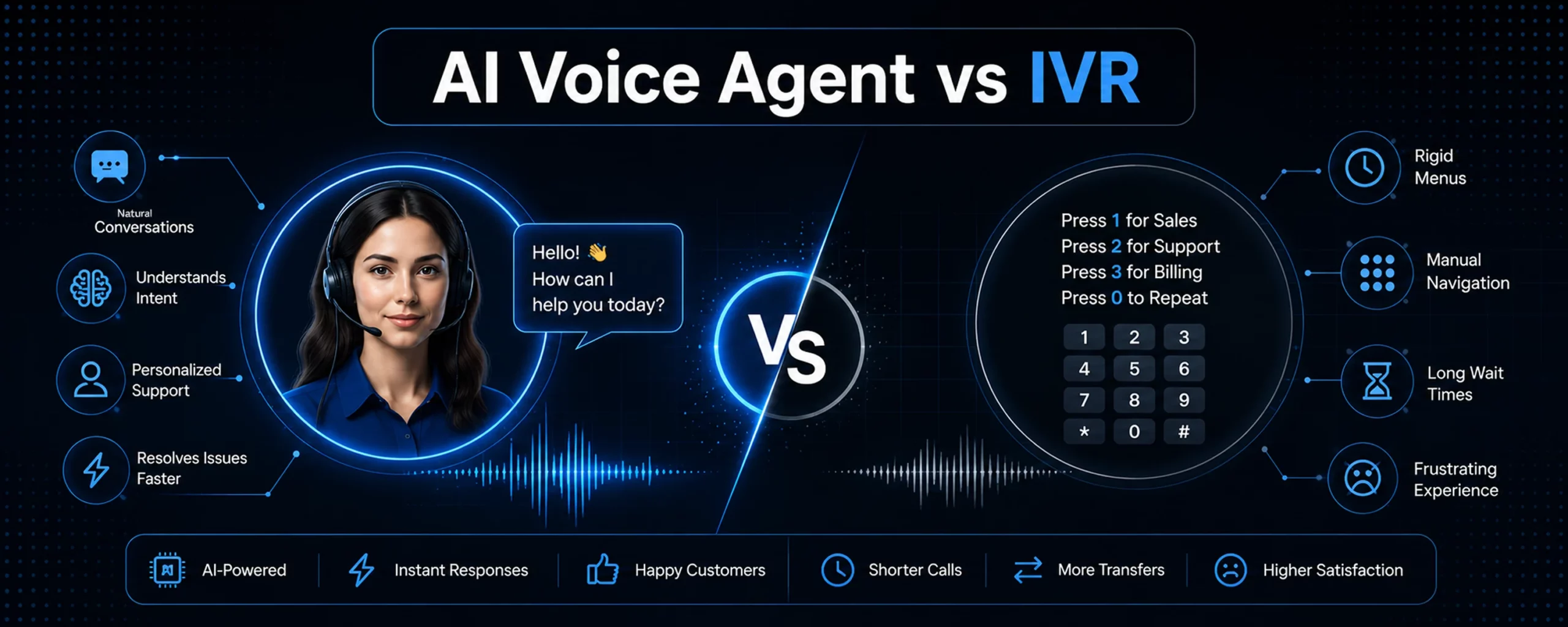
An IVR (Interactive Voice Response) system is the classic “press 1 for sales, press 2 for support” menu. It runs on a fixed script and a phone keypad, and it never deviates from that script. An AI voice agent, on the other hand, uses natural language processing to understand open-ended speech and hold a two-way conversation, much like a live rep would.
The practical difference shows up the moment someone calls in. IVR routes the call and stops there. An AI voice agent can book the appointment, pull up an account, or answer a question on the spot, without ever looping in a human.
| Feature | Traditional IVR | AI Voice Agent |
| Primary goal | Route calls | Resolve requests |
| Predictability | 100% deterministic, script-safe | Mostly reliable, small error risk |
| Setup cost | Low, quick to launch | Higher upfront, more setup work |
| Multilingual support | Separate pre-recorded trees per language | Dynamic, fluid switching |
| Best fit | High-compliance, low-volume lines | Repetitive inquiries, high call volume |
For a deeper technical breakdown of how the two systems actually process a call, our team put together the core technical difference between the two as a companion read.
User Experience: Menu Fatigue vs Natural Conversation
IVR menus create friction on purpose. Callers have to listen to a list, remember the right option, and press a button before they get anywhere close to help. Miss the option you wanted, and you’re stuck looping back through the whole menu again. That friction works fine if your goal is deflecting simple calls to a website.
AI voice agents remove that friction entirely. A customer just says what they need in plain English, and the system responds without forcing them through a decision tree. Independent CX research backs this up: customer experience research on call handling shows the conversational format consistently outperforms menu-based systems on satisfaction scores.
Here’s how that friction plays out at scale:
- 51% of consumers say they’ve abandoned a business entirely because of a bad IVR experience, not just a single call.
- A 2026 contact center survey found 67% of callers abandon an IVR interaction within 90 seconds if they can’t resolve their issue or reach a human.
- Among callers aged 18 to 44, that abandonment rate climbs to 78%.
- Of those who abandon, a large share don’t call back. They just try a competitor instead.
- Only about 56% of business calls nationally get answered by a live person in the first place.
Integrations: Cold Transfers vs Real-Time CRM Actions
This is where the two systems really split. IVR systems are largely “blind.” They can transfer a call to the right department, but they don’t pass any context along. That’s called a cold transfer, and it means the agent who picks up has to start from zero: name, account number, reason for calling, all over again.
AI voice agents work more like a consultant with a live connection to your systems. Because the agent is tied directly into your CRM or booking platform, it can pull up the caller’s history, update a record, or confirm an order status in real time, during the call itself. That’s closer to a warm transfer, but automated and instant.
If you’re planning to build this kind of setup yourself, our implementing inbound call automation guide walks through the actual build steps. For a look at how the backend architecture handles these live data calls under the hood, Bland’s breakdown of AI voice agents versus traditional systems is a solid technical reference.

Cost Breakdown: Per-Minute Pricing vs Opportunity Cost
IVR is cheap to run. Once the menu tree is built, it costs next to nothing per call. AI voice agents run on a usage-based model instead, typically landing somewhere around 15 to 20 cents per minute once you factor in transcription, the language model, and voice synthesis.
That sounds like a clear win for IVR until you look at what a missed call actually costs. Small and mid-sized businesses lose more than $126,000 a year on average to missed calls, and each unanswered call can cost anywhere from $200 to $1,200 depending on the industry. Compare that to hiring a receptionist at $20 to $30 an hour who can only handle one caller at a time, and the math shifts fast.
| Cost factor | Traditional IVR | AI Voice Agent | Human Receptionist |
| Setup cost | Low, one-time build | Moderate to high | Recruiting + training |
| Ongoing cost | Near zero per call | ~$0.15–$0.20 per minute | $20–$30 per hour |
| Concurrent calls | Unlimited (routing only) | Unlimited | One at a time |
| Missed-call risk | Low for routing, high for resolution | Very low | High during peak hours |
For a full side-by-side on setup versus long-term ownership costs, this ROI comparison between the two systems covers the numbers in more depth.
Risk & Control: Deterministic Scripts vs Probabilistic Conversation
IVR is deterministic. It plays the exact same recorded message to every caller, every time, with zero deviation. That predictability is exactly why regulated industries still lean on it.
AI voice agents are probabilistic. The system predicts the best next response based on context, which means it’s usually accurate and natural, but there’s a small, non-zero chance it misspeaks or over-promises something outside its guardrails. For a bank, hospital, or legal office, that risk profile matters a lot more than it does for a local clinic or contractor.
- Banking, healthcare, and legal lines often need the guaranteed script of an IVR.
- Retail, home services, and hospitality businesses can usually absorb the small AI risk in exchange for a better experience.
- Well-built AI agents use guardrails and escalation triggers to catch edge cases before they become a problem.
3CLogic’s comparison of IVR and voice AI goes deeper into where that compliance line typically sits.
Decision Framework: Which One Fits Your Business
The right answer depends almost entirely on your call volume, your compliance exposure, and how much of your revenue depends on someone actually picking up the phone.
| Business type | Best fit | Why |
| Large enterprise, heavy compliance | IVR as the front door | Predictability and strict routing matter more than speed |
| Small clinic, agency, or contractor | AI voice agent | Missed calls cost more than the per-minute fee |
| High call volume, repetitive questions | AI voice agent | Scales to unlimited simultaneous callers |
| Regulated finance or legal line | IVR, or AI with heavy guardrails | One wrong word carries real liability |
For most growing US businesses, the blocker isn’t whether AI voice agents work. It’s the build time. A custom voice agent built from scratch can take six to twelve months of development. That’s exactly the gap Isometrik’s Pre-built AI Agents close, with production-ready agents deployable in six to eight weeks instead of a year-long build. You can see how businesses across industries are already putting these systems to work in our breakdown of how AI agents are being deployed across industries.
At the end of the day, the AI Voice Agent vs IVR call comes down to one question: are you trying to filter traffic, or are you trying to capture every dollar walking through your phone line? Answer that honestly, and the rest of the decision gets a lot easier.