Best AI for Outbound Sales Calls: 6 Tools Worth Your Budget in 2026

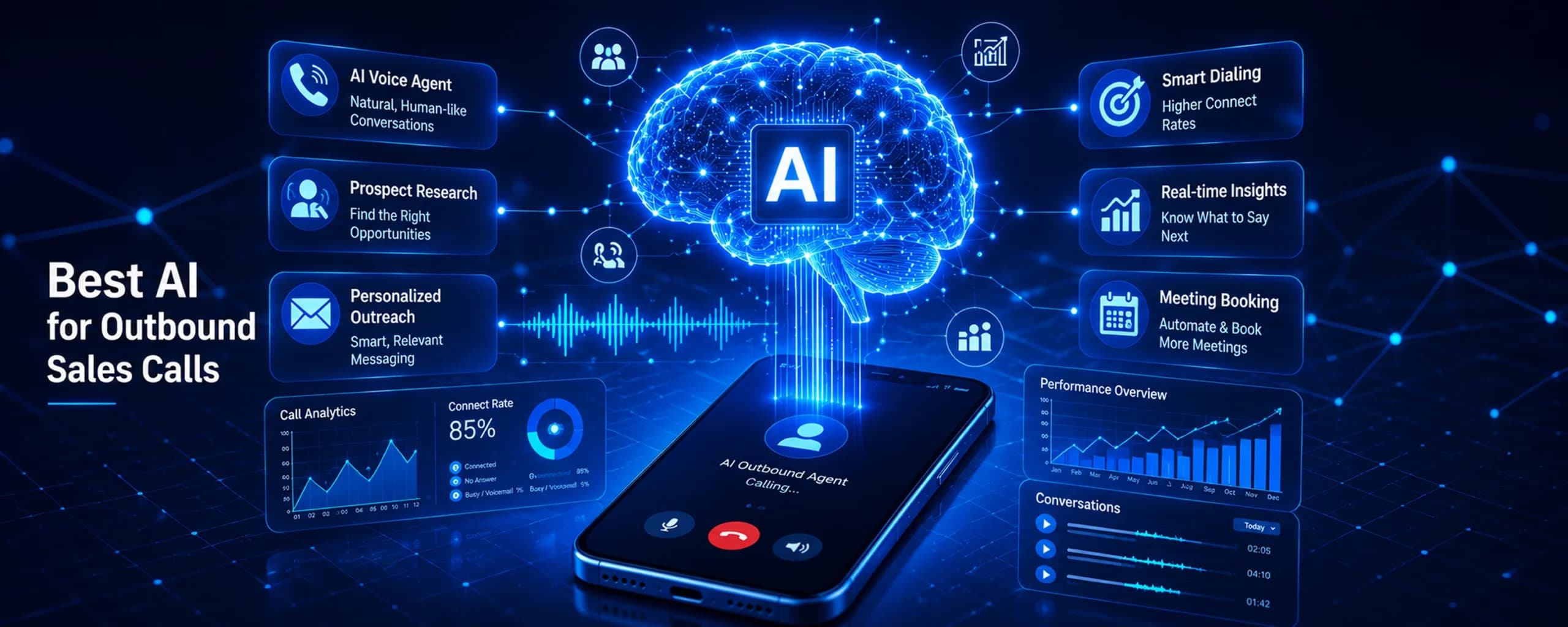
If you’ve been searching for the best AI for outbound sales calls, you’ve probably noticed the category got crowded fast. Two years ago, “AI cold calling” meant a robotic voice reading a script. In 2026, it means an agent that qualifies a lead, handles a curveball question, and books a meeting, all without a rep touching the phone. The gap between the tools that actually do this and the ones that just claim to is bigger than most buyers expect.
This blog details six platforms worth evaluating, what they cost, and how to tell which one fits your team, whether you’re running outbound from a U.S. sales floor or coordinating reps across time zones.
Why Outbound Teams Are Rethinking Cold Calling in 2026
A full-time U.S. cold caller costs $35,000 to $45,000 a year in salary alone, before benefits, training, or the six weeks it takes a new hire to sound confident on a call. That math hasn’t worked for a while, and 2026 hiring budgets have made it worse. Meanwhile, buyer expectations shifted just as fast. Prospects who fill out a form expect a callback in minutes, not days, and a rep who’s juggling forty other leads can’t hit that window consistently.
AI voice agents close that gap by handling the repetitive parts of outbound: dialing, initial qualification, objection handling on common questions, and calendar booking. Gartner projects that AI agents will outnumber human sellers 10 to 1 by 2028, though the same research is blunt that simply adding more bots doesn’t guarantee better results. The tools that win are the ones built around a clear qualification process, not just a natural-sounding voice.
This isn’t a U.S.-only shift. Teams in the UK, India, and APAC are running the same playbook, though U.S. teams face a stricter compliance layer that shapes which platform actually makes sense (more on that below).
Best AI for Outbound Sales Calls: 6 Tools Compared
Picking the best AI for outbound sales calls depends less on which tool has the flashiest demo and more on how your team actually works: do you want AI running full conversations independently, or AI assisting a human rep who’s still doing the talking? Here’s how six credible options break down.
Isometrik AI takes a different approach from most names on this list: instead of a per-minute subscription you rent forever, its Cold Calling product is deployed as an owned asset, typically in the $5,000–$25,000 range through the Pre-Built AI Teams tier, integrated with your existing CRM and Twilio-style telephony in four to six weeks. That model suits mid-market companies that want predictable, one-time costs and full control of their call data rather than a recurring per-minute bill that scales unpredictably with volume.
Retell AI is built for teams with engineering resources who want to construct their own outbound workflows. It handled unpredictable prospect interruptions well in independent testing and integrates tightly with CRMs through its API, but it assumes you’re comfortable configuring qualification logic yourself rather than using pre-built templates.
Bland AI leans even further into programmability. Sales teams use it to encode specific qualification frameworks like BANT directly into the call flow, which gives tight control but generally requires developer involvement to set up properly.
| Platform | Best For | Autonomy Level | Starting Price |
| Isometrik AI | Mid-market teams that want ownership, not a subscription | Fully autonomous outbound agent | $5,000–$25,000 one-time (Pre-Built AI Teams) |
| Retell AI | Developer teams building custom voice infrastructure | Fully autonomous, API-driven | From ~$0.07/minute |
| Bland AI | Technical teams wanting deep call-flow customization | Fully autonomous, programmable | From ~$0.09/connected minute |
| Synthflow | Non-technical teams wanting a no-code builder | Fully autonomous | From $29/month |
| Thoughtly | Revenue teams following up inbound leads across voice, SMS, email | Fully autonomous, multichannel | Custom pricing |
| Convoso | High-volume contact centers with compliance needs | Human-led with AI qualification layer | Custom pricing |
Synthflow trades some of that flexibility for speed. Its visual, no-code builder lets non-technical revenue teams launch a calling agent, adjust scripts, and add call templates without writing a line of code, making it a common starting point for smaller teams testing AI outbound for the first time.
Thoughtly is built specifically for the follow-up motion: a lead fills out a form or misses an inbound call, and the same agent calls back within roughly sixty seconds, qualifies them, and follows up by SMS and email if the first call doesn’t convert. It’s a strong fit if your outbound problem is really an inbound-response problem.
Convoso sits closer to the traditional contact-center world. It pairs a predictive dialer with an AI qualification layer and heavy TCPA compliance tooling, including DNC scrubbing and consent management, which makes it the pick for operations dialing thousands of numbers a day rather than a lean outbound team.
How to Choose the Right Platform for Your Team
Before comparing feature lists, decide what you actually need the AI to own. That single decision filters out half the market.
| Question | Why It Matters |
| Should AI run the full call, or assist a human rep? | Autonomous agents (Isometrik, Retell, Synthflow) replace dial time. Assist tools (Kixie, Aloware) speed up reps who still talk. |
| Do you need it live in weeks or months? | Pre-built platforms deploy in 4–6 weeks; developer-first tools need longer setup. |
| How deep does CRM integration need to be? | Look for structured write-back (qualified, callback, DNQ) into HubSpot or Salesforce, not just a call log. |
| Is pricing predictable at your call volume? | Per-minute models scale with usage; one-time deployment costs don’t. |
| Who owns the call data and workflow? | Owned deployments avoid vendor lock-in; subscription platforms typically don’t. |
A few practical filters worth applying:
- If your team has no engineering support, rule out heavily developer-first platforms first.
- If you’re calling leads back within minutes of a form fill, prioritize speed-to-dial over voice customization.
- If compliance exposure is your biggest worry, weight DNC scrubbing and consent management above conversation flexibility.
- If you want to own the system long-term, compare one-time deployment cost against three years of per-minute fees before deciding.
AI vs. Human SDR Cost: What You Actually Save
The honest comparison isn’t “AI versus humans,” it’s which tasks each one should own. Most outbound teams that get this right free up 60–70% of the time a human SDR previously spent on research and dialing, redirecting it to the conversations that need real judgment.
| Cost Factor | Human SDR (U.S.) | AI Outbound Agent |
| Annual cost | $35,000–$45,000+ salary alone | $5,000–$25,000 one-time deployment, or per-minute usage |
| Ramp time | Weeks to months | Days after setup |
| Scaling cost | Roughly linear per new hire | Marginal, mostly usage-based |
| Best use | Complex objections, enterprise conversations | High-volume qualification, first-touch outreach |
This is the same conclusion our own breakdown on AI SDR vs. human SDR costs reaches: AI handles the volume, humans handle the conversations that are actually worth a human’s time. Teams that try to force one tool to do both jobs usually end up disappointed with the results.
Staying Compliant: TCPA Rules for AI Outbound Calls
Here’s the part that trips up U.S. teams moving fast: the FCC has confirmed that TCPA rules apply to AI-generated voices exactly as they apply to prerecorded human ones. That means prior express consent before an AI agent dials a cell phone, proper caller identification, and honoring opt-out requests through any reasonable method. Violations carry statutory damages of $500 to $1,500 per call, with no cap, which makes this a budget line item, not a footnote.
Any platform you shortlist should have DNC list scrubbing, consent tracking, and calling-hour restrictions built in rather than left entirely to you to manage. If you’re calling outside the U.S., build in time to check local equivalents. The EU and UK lean on GDPR-style consent requirements, and several APAC markets are drafting their own AI-disclosure rules, so a compliance framework built for one region rarely transfers cleanly to another.
Getting Started with AI Outbound Calling
Once you’ve narrowed the list, a short pilot beats a long RFP. Run one qualification script, one lead segment, and one CRM integration for 30 days before expanding.
- Map your current outbound workflow and flag where reps lose the most time to manual dialing.
- Pick one platform from your shortlist and configure a single qualification script.
- Connect it to your CRM so call outcomes write back automatically, not manually.
- Run a 30-day pilot against a defined lead segment before rolling out further.
- Compare pilot results against your current cost per qualified meeting.
If you’re weighing an owned deployment against an open-ended subscription, it’s worth seeing what a Pre-Built AI Team actually looks like in production, and how it compares to the broader lead generation tooling most sales teams already have in their stack. Isometrik AI’s own AI Cold Calling product follows this model: deployed on your infrastructure, integrated with your CRM, and owned outright rather than rented indefinitely.
Whichever platform you land on, the best AI for outbound sales calls in 2026 is the one that matches how your team actually sells, not the one with the longest feature list.