n8n vs Zapier for AI Workflows: Which One Actually Fits in 2026

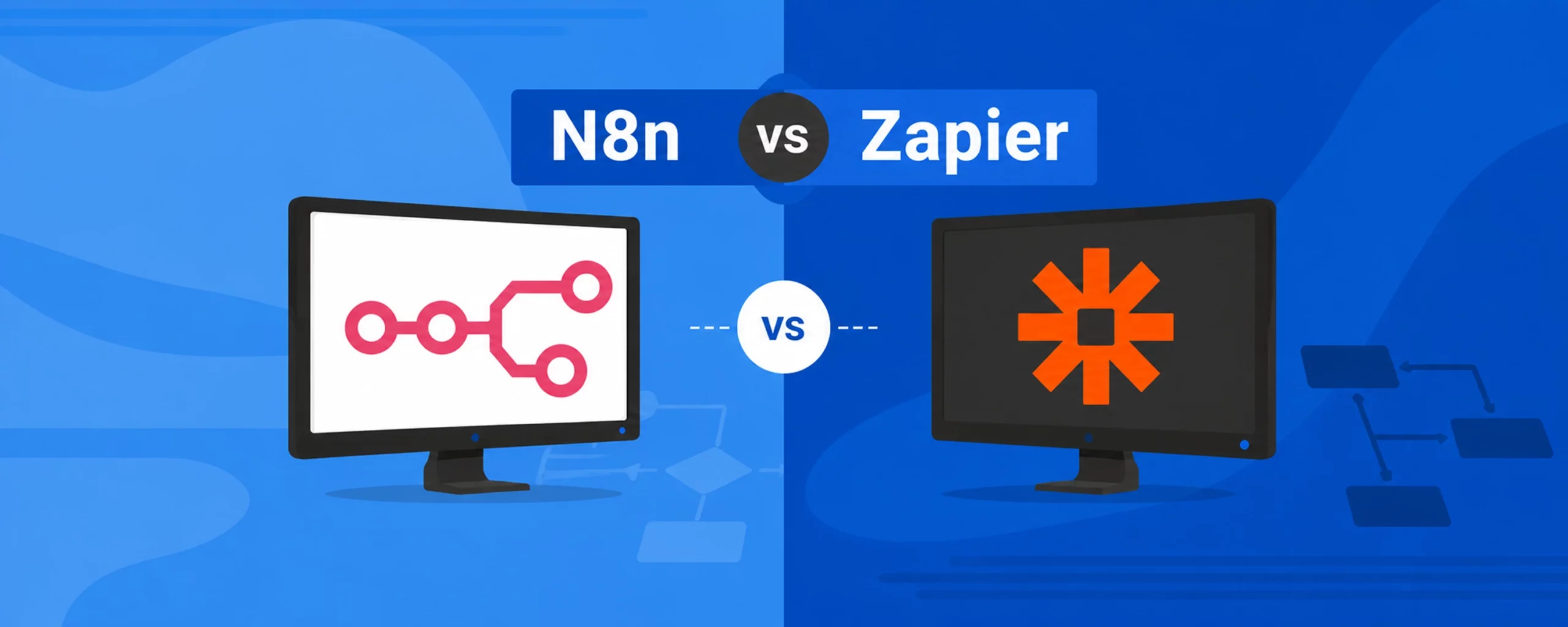
Every team building AI-powered automation eventually runs into the same question: n8n vs Zapier for AI workflows? Both platforms added serious AI capabilities over the past year, and both now market themselves as ready for agentic workflows. But “supports AI” and “built for AI” are two very different claims, and the gap between them shows up fast once you’re trying to run an actual production workflow instead of a demo.
This guide breaks down how n8n and Zapier actually compare for AI workflows in 2026, where each one falls short, and why businesses building serious AI agents often end up looking past both toward a platform designed for this from the ground up.
Zapier for AI Workflows: What It’s Actually Good At
Zapier’s core strength hasn’t changed with the addition of AI: it makes automation accessible to anyone, regardless of technical background. For AI workflows specifically, this shows up in a few ways:
- Zapier Copilot lets users describe an automation in plain language, and the AI assistant asks clarifying questions before building out the workflow, including agentic steps and app connections.
- Zapier Agents enable autonomous task execution across thousands of connected apps without writing code, positioning Zapier as a full AI orchestration suite rather than a simple trigger-action tool.
- Massive integration library, now numbering in the thousands of AI-focused apps alone, means connecting to a mainstream SaaS tool almost never requires custom setup.
The tradeoff is depth. Zapier’s AI features are built for sequencing pre-built actions rather than constructing genuine reasoning agents. If a specific API operation isn’t already exposed as an action, you’re limited to workarounds or a fairly constrained custom code step.
n8n for AI Workflows: What It’s Actually Good At
n8n has positioned itself as the AI-native option, and the technical differences back that up:
- Native LangChain integration since n8n 2.0 gives developers direct access to the frameworks used to build genuine AI agents, not just call an API and pass along the response.
- 70+ dedicated AI nodes cover large language models, embeddings, vector databases, speech recognition, OCR, and image generation, letting teams build multi-step reasoning pipelines rather than single AI actions.
- Persistent agent memory across executions supports agents that need context to carry over between runs, a core requirement for anything resembling a real conversational agent.
- Self-hosted local LLM support via tools like Ollama, which matters for teams with data residency requirements or a preference for keeping inference in-house.
n8n treats AI nodes as first-class workflow components, while Zapier packages AI as a premium add-on feature.
For automation projects heavily integrating AI, n8n represents the more technically capable option in 2026, while Zapier remains the more accessible way to add basic AI to simple workflows.
The tradeoff here is setup complexity. n8n’s node-based canvas and JSON-level data handling require real technical comfort, and self-hosting means retries, error handling, and infrastructure monitoring become your team’s responsibility, not the platform’s.
Side-by-Side Comparison
| Factor | Zapier | n8n |
| Best for | Non-technical teams, fast setup | Technical teams, AI-native workflows |
| Integrations | 7,000-9,000+ pre-built apps | 400+ native nodes, unlimited via HTTP/API |
| AI architecture | AI actions and Agents (sequenced steps) | Native LangChain, 70+ AI nodes, persistent memory |
| Pricing model | Per task (each action counts) | Per execution (entire workflow = one unit) |
| Self-hosting | Not available, cloud only | Yes, full infrastructure control |
| Learning curve | Low | Moderate to steep |
| Cost at scale | Rises quickly with multi-step workflows | Can cut costs 80-90% for complex workflows |
Where Both Platforms Still Fall Short for AI Products
Here’s the part that matters most for businesses actually trying to build an AI-powered product, not just automate internal tasks. Both n8n and Zapier are workflow automation tools that happen to support AI. Neither was built specifically to power a customer-facing AI experience.
That distinction matters because building those experiences on top of either platform still requires assembling a lot of surrounding infrastructure yourself:
- Voice infrastructure: Neither platform natively handles telephony, call routing, or real-time voice conversation, which requires separate voice AI infrastructure entirely.
- Multi-tenant architecture: If you’re building an AI product for multiple clients or business units, neither platform gives you multi-tenancy, role-based access control, or white-label capability out of the box.
- Production-grade agent orchestration: Chaining together workflow nodes is different from running a production AI agent team that handles sales, support, and operations reliably at scale.
- Compliance infrastructure: SOC 2 or HIPAA-grade audit logging isn’t a core feature of either tool; it needs to be built or bolted on separately.
Why Businesses Building AI Products Look Beyond Workflow Tools
For teams automating internal processes, n8n or Zapier is often exactly the right call, and the decision between them comes down to team size, budget, and how much infrastructure control you actually need. But for businesses trying to build or launch an actual AI product, whether that’s a conversational AI layer, a voice agent, or a full AI SaaS platform, workflow automation tools are solving a different problem entirely.
This is where Isometrik AI fits in. Rather than stitching together nodes and API calls to approximate an AI agent, Isometrik provides production-ready AI agents, voice infrastructure, and a visual agent builder already built and tested across real deployments. A few reasons this matters for teams thinking beyond simple automation:
- Pre-built AI teams: Sales, support, and operations agents that integrate into existing workflows in 6 to 8 weeks, instead of building agent logic from scratch on a general automation tool
- Voice AI infrastructure included: Complete infrastructure for inbound and outbound voice campaigns, something neither n8n nor Zapier is built to handle natively
- Agent Studio for custom workflows: A no-code, drag-and-drop builder for multi-agent workflows with 100+ templates, purpose-built for AI agents rather than general app-to-app automation
- Enterprise-ready from day one: Multi-tenant architecture, role-based access control, and SOC 2 and HIPAA-ready audit logging built in, not assembled after the fact
- Full ownership option: Businesses can own the complete source code and infrastructure rather than depending on a subscription-based automation platform indefinitely
For a business deciding between building an AI workflow on n8n, Zapier, or a platform actually designed for AI products, the right choice comes down to what you’re building. If it’s internal process automation, the n8n versus Zapier decision matters a great deal. If it’s a customer-facing AI product, Isometrik AI is built for exactly that from the ground up.
Conclusion
The n8n versus Zapier decision is a real one, and it comes down to how technical your team is, how complex your workflows are, and how much infrastructure control you actually need. But if what you’re building is an AI product rather than an internal automation, the more useful question isn’t which workflow tool to pick. It’s whether you want to spend months assembling AI infrastructure from workflow nodes, or start from a platform built for it.
Isometrik AI gives businesses production-ready AI agents, voice infrastructure, and a visual agent builder already proven across real deployments, so you can launch in weeks instead of building your AI stack one node at a time.