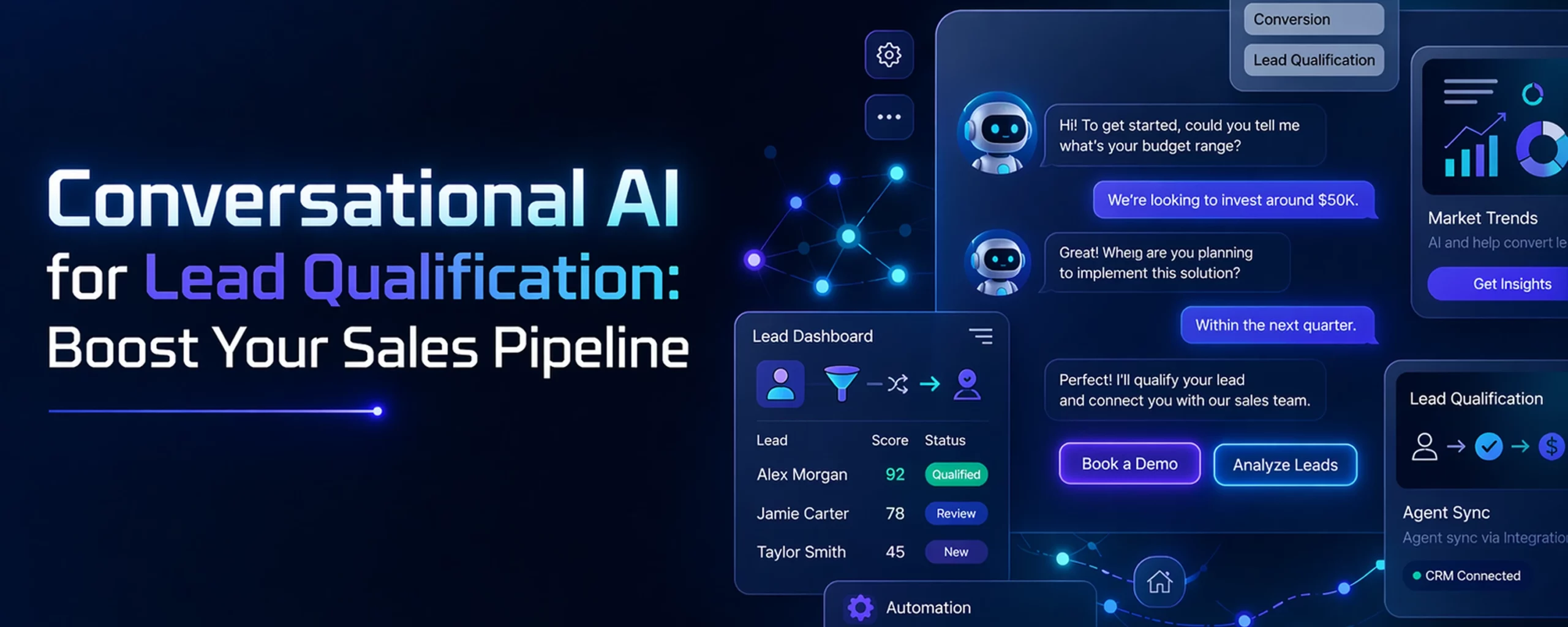
Conversational AI for Lead Qualification: Boost Your Sales Pipeline

Sales teams in mid-market and enterprise companies face mounting pressure to fill pipelines quickly. Manual lead qualification often involves SDRs sifting through emails, calls, and forms. This process is time-intensive and error-prone. Prospects wait days for responses, leading to lost opportunities.
Conversational AI for lead qualification changes that.
Consider a typical US-based SaaS firm with 200 employees. Their sales team handles 500 inbound leads monthly but qualifies only 20% effectively. The rest get lost in follow-ups or misprioritized. This results in stretched resources and missed revenue targets.
Key pain points include:
- Scalability issues: Human teams can’t handle volume spikes without hiring.
- Low response rates: Cold outreach sees under 5% engagement.
- Inconsistent scoring: Subjective judgments lead to poor lead quality.
These challenges inflate cost per lead (CPL) to $200-500. Without automation, growth stalls as headcount rises.
What Is Conversational AI for Lead Qualification?
Conversational AI for lead qualification refers to intelligent systems like chatbots and voice agents that simulate human-like interactions. Powered by natural language processing (NLP) and machine learning, they engage prospects on websites, apps, or messaging platforms.
Unlike basic forms, these tools ask dynamic questions based on responses. For example, a visitor to an e-commerce site might chat with an AI agent that probes budget, timeline, and pain points. The system scores the lead instantly and routes high-potentials to sales reps.
In the US market, tools integrate with platforms like HubSpot or Salesforce. They handle 80% of initial interactions, freeing humans for complex deals.
| Component | Description | Example Use Case |
| NLP Engine | Understands intent and context | Parses “We’re expanding our team” to qualify hiring needs |
| Scoring Algorithm | Assigns points based on criteria | Budget >$50K = +20 points; Urgent timeline = +15 points |
| Integration Layer | Syncs data with CRM | Updates lead status in real-time via API |
This approach turns passive leads into active conversations, aligning with buyer preferences for instant engagement.
Key Benefits and ROI of Conversational AI for Lead Qualification
Adopting conversational AI transforms sales efficiency. It qualifies leads 24/7 without fatigue, handling thousands of interactions daily. US enterprises report 30-50% faster qualification cycles, moving prospects to demos quicker.
ROI stems from cost savings and revenue uplift. Manual qualification costs $50-100 per lead in labor. AI drops this to $10-20 by automating 70% of tasks. Conversion rates rise as qualified leads are warmer and better matched.
Conservative benchmarks show:
- Time savings: 40-60% reduction in SDR hours.
- Lead quality: 25-40% improvement in close rates.
- Overall ROI: 200-400% within 12 months, per industry reports.
A logistics firm might see $500K annual savings on a $100K investment. Track metrics like CPL, qualification rate, and pipeline velocity to quantify gains.
| Metric | Traditional Method | With Conversational AI | Improvement |
| Qualification Time | 2-5 days | 5-30 minutes | 80-95% faster |
| Cost Per Qualified Lead | $150-300 | $30-80 | 70-80% lower |
| Conversion to Opportunity | 15-25% | 35-50% | 2x uplift |
These benefits make it ideal for sales heads aiming to scale without adding staff.
How Conversational AI Integrates with Your Existing Sales Stack
Seamless integration is key for adoption. Conversational AI plugs into CRMs, email tools, and analytics platforms via APIs. For US businesses using Salesforce or Microsoft Dynamics, setup involves mapping data fields and defining triggers.
Start with website embedding for chat widgets. Voice options connect to phone systems for inbound calls. Multi-channel support covers SMS, email, and social media.
Implementation takeaways:
- Pilot phase: Test on 20% of leads to refine scripts.
- Data security: Ensure GDPR/HIPAA compliance for sensitive info.
- Training: Fine-tune AI on historical data for accuracy.
Timelines vary: basic setups take 2-4 weeks; custom integrations, 4-8 weeks. Post-launch, monitor engagement to optimize.
A banking client integrated AI with their ATS, qualifying 300 leads weekly while syncing scores to reps’ dashboards.
Build vs. Buy: Deciding on Your Conversational AI Strategy
Mid-market firms often debate building in-house versus buying off-the-shelf. Building offers customization but demands developer resources and 6-12 months. Costs range $50K-200K initially, plus maintenance.
Buying pre-built solutions accelerates deployment. Platforms provide templates for lead qualification, with costs $5K-50K annually. They handle scaling and updates, ideal for teams short on tech expertise.
| Factor | Build In-House | Buy Platform |
| Time to Launch | 6-12 months | 2-6 weeks |
| Upfront Cost | $50K-200K | $5K-50K/year |
| Customization | High | Medium (via configs) |
| Ownership | Full control | Vendor-dependent |
| Scalability | Manual | Built-in |
For most US operations leaders, buying wins for speed and ROI. Custom builds suit unique needs like proprietary data models. Hybrid approaches blend both for optimal results.
Real-World Scenarios: Implementing Conversational AI Successfully
A US healthcare provider with 1,000 employees was qualifying leads manually, delaying partnerships. They deployed conversational AI on their site, asking about patient volume and compliance needs. Within three months, qualified leads rose 35%, cutting CPL by 45%.
In e-commerce, a retailer used voice AI for phone inquiries. Agents qualified buyers on order size and frequency, routing VIPs instantly. This shortened sales cycles from 14 to 7 days, boosting revenue 28%.
Takeaways for rollout:
- Define criteria: Budget, authority, need, timeline (BANT framework).
- A/B test: Compare AI vs. human qualification.
- Measure iteratively: Adjust based on drop-off points.
Enterprises see pilots yield 150% ROI, justifying expansion.
Overcoming Challenges in Conversational AI Deployment
Resistance to AI often stems from accuracy fears or integration hurdles. Early bots felt robotic, but modern NLP achieves 90%+ understanding. Train on domain-specific language to mitigate.
Data privacy is critical in the US, with CCPA regulations. Choose compliant vendors to avoid fines.
Common pitfalls and solutions:
- Low adoption: Personalize interactions to build trust.
- Over-reliance: Use AI for initial qualification, humans for closes.
- Bias in scoring: Audit algorithms regularly.
With proper setup, challenges fade, unlocking sustained value.
Conversational AI for lead qualification empowers sales teams to focus on high-value activities. By automating routine tasks, it drives efficiency and growth for US businesses navigating competitive markets.
Platforms like Isometrik AI help organizations deploy production-ready conversational AI agents tailored for lead qualification, integrating seamlessly with existing tools to deliver fast ROI without lengthy development.