Steps to Adopt AI in Business: A Practical Guide for US Companies

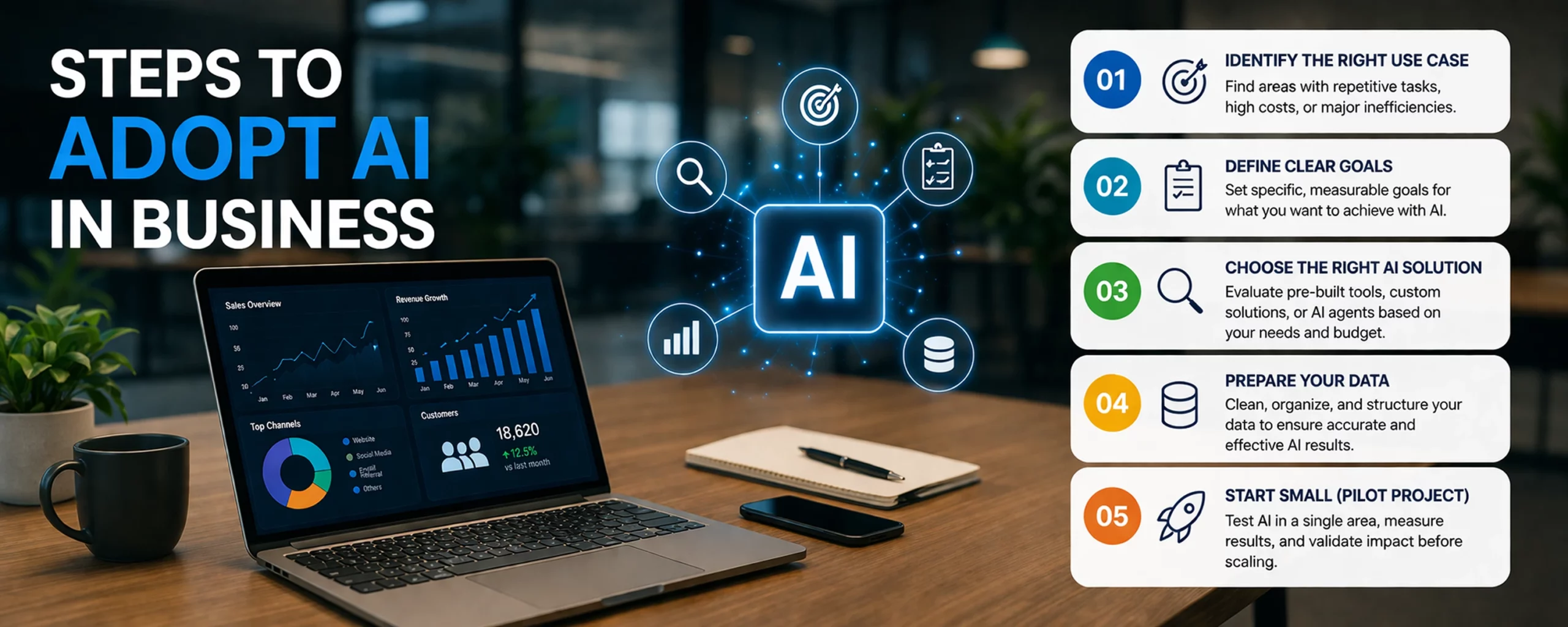
Adopting AI in business can transform operations, but only if done right. For US companies with 50 to 5,000 employees and revenues from $10M to $500M, the pressure to integrate AI is real. Leaders in sales, recruitment, and customer experience face manual workloads that slow growth. This guide outlines clear steps to adopt AI in business, focusing on practical decisions that deliver ROI quickly.
Many firms rush into AI without a plan, leading to stalled projects or wasted budgets. Instead, follow a structured path. We’ll cover assessment, team building, solution selection, implementation, measurement, and scaling.
Each step includes real-world examples from sales automation, talent hiring, and support workflows. By the end, you’ll have actionable takeaways to move forward confidently.
Step 1: Assess Your Business Needs and Readiness
Before diving into AI tools, evaluate where your business stands. Start by mapping pain points. In sales, manual prospect research eats up SDR time. Recruitment teams spend hours screening resumes. Operations leaders deal with ticket backlogs that strain support staff.
Conduct an internal audit. Gather input from heads of sales, HR, and operations. Ask: Which processes are repetitive? Where do delays cost money? For a mid-market logistics firm, this might reveal AI opportunities in route optimization or inventory forecasting.
Use a simple framework to score readiness:
| Readiness Factor | Questions to Ask |
| Data Availability | Do you have clean data in CRM or ATS systems? |
| Tech Infrastructure | Are ERP or workflow tools AI-compatible? |
| Team Skills | Is your staff open to AI training? |
| Budget Alignment | Can you allocate $5K–$50K for initial pilots? |
| Regulatory Fit | Does AI comply with US data privacy laws like CCPA? |
Aim for an average score above 3. If low, address gaps first. This step prevents mismatched investments. Takeaway: Focus on 2–3 high-ROI areas, like automating lead qualification, to build momentum. Expect this phase to take 2–4 weeks.
Realistic ROI here? Firms see 20–30% efficiency gains in targeted processes within months, per industry benchmarks.
Step 2: Assemble the Right Team and Expertise
AI adoption fails without skilled people. Don’t go solo — build a cross-functional team. Include a CTO or digital lead for tech oversight, sales heads for revenue insights, and operations reps for workflow details.
For mid-market US businesses, internal expertise may fall short. Consider partnering with AI consultants who handle deployment. This avoids long learning curves and ensures compliance with US standards.
Key roles and responsibilities:
- Project Lead (CTO or Ops Head): Oversees timelines and integrations.
- Domain Expert (Sales/HR Lead): Defines use cases, like AI for candidate matching.
- AI Specialist (Internal or External): Selects and customizes tools.
- Change Manager: Trains staff to embrace AI without resistance.
Budget for training: $2K–$10K per team member for workshops. In recruitment, a talent ops leader might lead an AI pilot for resume screening, reducing time-to-hire by 40%.
| Internal Team | Partner Approach |
| Pros: Full control, lower long-term costs | Pros: Faster rollout, expert guidance |
| Cons: Slow setup, skill gaps | Cons: Initial fees ($10K–$100K) |
| Best for: Tech-mature firms | Best for: Quick ROI focus |
Takeaway: Start small with one champion per department. Implementation timeline: 1–2 months to form and align the team. This step ties directly to buying triggers like missed targets — AI teams scale output without headcount hikes.
Step 3: Choose the Right AI Solutions: Build vs. Buy
Now, select tools that fit your needs. Steps to adopt AI in business hinge on this decision. Evaluate build (custom development) versus buy (off-the-shelf platforms).
For sales, buy ready-made AI agents for lead scoring if you use Salesforce. In healthcare or banking, build custom for compliance. US enterprises often mix both: buy core chatbots, build integrations.
Factors to weigh:
- Cost: Buy starts at $5K/month; build $50K–$200K upfront.
- Timeline: Buy deploys in weeks; build takes 3–6 months.
- Scalability: Platforms handle growth; custom fits unique workflows.
- Ownership: Build avoids vendor lock-in; buy offers quick updates.
Example: A SaaS company buys an AI recruitment tool to automate interviews, integrating with ATS like Workday. ROI? 25–50% faster hiring cycles.
| Solution Type | Use Case Example | Estimated Cost | Timeline to Value |
| Off-the-Shelf (Buy) | Voice bots for customer queries | $10K–$30K/year | 4–6 weeks |
| Custom Build | Multi-agent systems for supply chain | $100K+ | 3–6 months |
| Hybrid | AI-enhanced CRM for sales pipelines | $20K–$80K | 2–3 months |
Takeaway: Prioritize solutions with proven US integrations. Test via pilots to confirm fit. This step resolves core problems like disconnected tools, ensuring AI boosts revenue without complexity.
Step 4: Implement AI Securely and Efficiently
With solutions chosen, roll out thoughtfully. Start with pilots in one department — sales for lead gen, recruitment for screening, or ops for ticket routing.
Secure integration is key. Link AI to existing systems like CRM (HubSpot) or ERP (SAP). For US firms, prioritize data security under GDPR influences and CCPA.
Phased approach:
- Pilot Setup (Week 1–2): Deploy in a sandbox. Train users on AI interactions.
- Testing (Week 3–4): Monitor for errors, like false positives in candidate matching.
- Go-Live (Week 5+): Scale to full use, with fallback manual processes.
In banking, an AI chatbot handles routine queries, cutting support costs by 30%. Challenges? Staff adoption — counter with demos showing time savings.
Implementation costs: $20K–$150K, including setup. Timeline: 1–3 months for production-ready systems.
Takeaway: Document workflows pre- and post-AI to quantify wins. This minimizes risks like project stalls, aligning with leadership demands for quick outputs.
Step 5: Measure ROI and Optimize Performance
AI isn’t set-it-and-forget-it. Track metrics from day one to prove value. Focus on business outcomes: reduced costs, faster cycles, higher output.
Key KPIs by function:
- Sales: Lead conversion rate up 15–25%, cost per lead down 20%.
- Recruitment: Time-to-hire reduced 30–50%, recruiter productivity +40%.
- Operations: Ticket resolution time cut 50%, support costs -25%.
Use dashboards in tools like Google Analytics or built-in AI analytics. If ROI lags, tweak — e.g., refine AI prompts for better accuracy.
| Metric | Pre-AI Baseline | Post-AI Target | ROI Calculation |
| Hiring Cycle | 45 days | 25–30 days | (Time saved x Recruiter salary) / Project cost |
| Support Tickets | 100/day manual | 70% automated | Cost savings = Tickets x Avg. handle time x Wage |
| Sales Pipeline Speed | 60 days | 40–45 days | Revenue lift / AI investment |
Takeaway: Review quarterly. Adjust based on data — e.g., if AI in logistics overpromises, scale back. This step ensures sustained gains, addressing rising costs without extra hires.
Step 6: Scale AI Across the Organization
Once pilots succeed, expand. Steps to adopt AI in business culminate here: integrate enterprise-wide.
Start with wins — replicate sales AI in marketing, or recruitment bots in onboarding. For a $100M US retailer, scaling AI agents across e-commerce cut manual follow-ups by 60%.
Challenges: Integration silos, budget creep. Mitigate with modular designs.
Scaling tips:
- Secure executive buy-in with pilot data.
- Invest in ongoing training ($5K/year per team).
- Monitor ethics — ensure AI fairness in hiring.
- Plan for updates; AI evolves fast.
Timeline: 3–6 months post-pilot. Total adoption ROI: 2–5x return in 12–18 months for mid-market firms.
Takeaway: Build a roadmap for 1–2 years. This positions your business for growth, solving disconnected workflows permanently.
Adopting AI transforms challenges into advantages. By following these steps to adopt AI in business, US leaders can automate manual work, cut costs, and drive revenue. Focus on practical execution for lasting impact.
Platforms like Isometrik AI help organizations deploy production-ready AI agents without long development cycles. Their expertise in custom integrations for CRM and ATS systems ensures smooth adoption, tailored to US business needs for measurable results.