TCPA Compliant AI Calling: What Businesses Need to Know in 2026

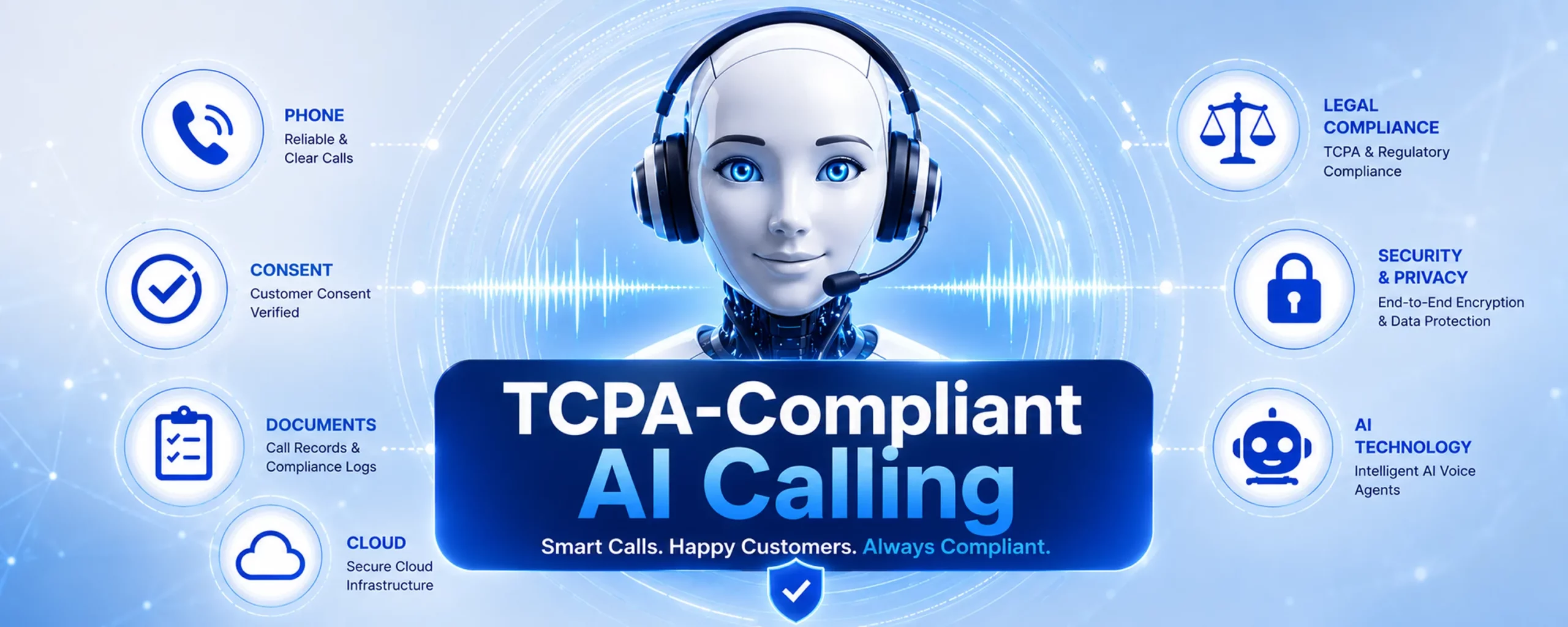
TCPA compliant AI calling is no longer optional guidance — it’s the baseline for any business using AI voice agents to reach customers. The Federal Communications Commission confirmed in 2024 that AI-generated voices count as “artificial or prerecorded voice” under the Telephone Consumer Protection Act (TCPA).
That single ruling reshaped how outbound AI calling programs get built, from lead-gen campaigns to appointment reminders. For entrepreneurs, sales teams, and SaaS founders scaling outbound calls, understanding these rules is the difference between a scalable channel and a lawsuit waiting to happen.
This blog breaks down what compliant outbound AI voice calling actually requires, where the rules are still shifting, and how to build a program that holds up under scrutiny — in the US and beyond.
What TCPA Compliant AI Calling Actually Means
The TCPA was written in 1991, long before anyone imagined a voice agent that sounds human. The FCC closed that gap with its February 2024 declaratory ruling. It confirmed that any technology generating a human-sounding voice, including real-time conversational AI and voice cloning, falls under existing TCPA restrictions.
That means TCPA compliant AI calling requires the same core protections as traditional robocalls: prior consent, clear disclosure, and a working opt-out. Businesses that once assumed “it’s not a recording, it’s AI” no longer have that argument. Whether you’re running debt collection reminders, sales outreach, or appointment confirmations, the compliance bar is set by call purpose, not by how advanced the underlying voice model is.
Three things determine your obligations:
- The purpose of the call — informational versus marketing
- Whether the number is mobile or residential
- Whether the recipient has given documented consent
Get any of these wrong, and a single AI-generated call can trigger statutory damages.
Why the FCC’s 2024 Ruling Changed Everything
Before 2024, some businesses treated AI voice as a gray area, not quite “prerecorded,” not quite a live human either. The FCC’s ruling erased that ambiguity. It classified AI voice technology as fully subject to the same TCPA provision governing traditional robocalls.
The regulatory picture has kept moving since then. A federal rule that would have required separate consent for each individual seller named on a lead form was adopted, then vacated by an appeals court in early 2025 before it ever took effect. Bundled lead-generation consent is legal again federally, though several states apply stricter standards of their own.

A federal mandate requiring AI systems to announce themselves at the start of every call also remains a proposal, not settled law, though states like Utah, Texas, and Colorado already impose their own disclosure or timing requirements.
Courts have also grown more willing to narrow TCPA’s reach following a recent Supreme Court decision, including debate over whether text messages should be treated the same as calls. None of this changes the core rule for AI voice; it’s still an “artificial voice” under the TCPA. But it signals the landscape isn’t static. Build your outbound AI voice program for the strictest applicable rule, not the most convenient one.
Core Consent Requirements: PEC vs. PEWC
Consent is the foundation of any compliant outbound AI voice program, and the type required depends entirely on why you’re calling.
Prior Express Consent (PEC) covers informational or transactional calls, like appointment reminders, delivery updates, or account alerts. It can be given orally or in writing, and it’s often implied by an existing relationship.
Prior Express Written Consent (PEWC) is required for any marketing or telemarketing call using an AI-generated voice. This consent must be a standalone, signed agreement, not buried in a terms-of-service page or tied to a purchase.
| Feature | Prior Express Consent (PEC) | Prior Express Written Consent (PEWC) |
| Use case | Informational, transactional calls | Marketing, telemarketing, promotions |
| Format | Oral or written | Written, signed, E-SIGN compliant |
| Disclosure | Standard business identification | Must name the AI/automated nature of the call |
| Tied to purchase? | N/A | Cannot be a condition of sale |
For B2B campaigns, remember that TCPA still applies to any mobile number, even a decision-maker’s business cell phone. Publicly listed corporate landlines are generally the only exception.
Mandatory Disclosures and Opt-Out Mechanics
Consent gets you permission to call. Disclosure and opt-out rules govern what happens once the call connects. Every AI-initiated call should:
- Identify the calling business by name, right at the start
- State the purpose of the call clearly
- Offer a simple, spoken or key-press way to opt out
- Provide a callback number if the message could reach voicemail
- Process opt-out requests immediately, across every connected system
A typical opening might sound like: “This is an AI assistant calling on behalf of [Company]. Say ‘stop’ anytime to opt out.” That single line satisfies disclosure intent and starts the opt-out clock at once.
Opt-outs matter more than most businesses expect. Once someone opts out of an AI call, that request typically applies to all future outbound contact from your business, not just one campaign. A modest opt-out rate compounds fast, shrinking your reachable database meaningfully within a year.
Do Not Call Scrubbing and Record-Keeping
Staying compliant also depends on what happens before you dial. Contact lists need regular scrubbing against the National Do Not Call Registry, and ideally against state-level lists too, since state rules on automatic dialing devices vary widely in their disclosure and timing requirements.
Record-keeping is what makes your compliance program defensible if it’s ever challenged. At minimum, retain the following:
| Record Type | What to Capture | Suggested Retention |
| Consent records | Timestamp, signature, disclosure text, source | 4–5 years |
| DNC scrub logs | Scrub date, registry version, matches found | 4–5 years |
| Call logs | Timestamp, duration, outcome, opt-out flags | 4–5 years |
| Internal suppression list | Number, date and method of opt-out | Ongoing |
Dialzara’s compliance guide walks through detailed PEWC documentation requirements, including specific fields worth capturing at the point of consent. It’s a useful reference if you’re designing your own consent-capture flow.
A Global Perspective: Beyond US Borders
If your outreach touches customers outside the US, TCPA isn’t the only framework in play. The UK’s Privacy and Electronic Communications Regulations and the EU’s GDPR apply similar principles: consent before contact, disclosure of automation, and strict limits on storing voice data. Retell AI’s overview of AI phone call ethics is a useful starting point for teams calling into multiple regions at once, particularly on the data-privacy side.
Calling US prospects from a UK or EU base still triggers US rules, and the reverse is also true. Global outreach means accepting global responsibility. A compliance program built around only one region’s rules will eventually run into a gap.
Building a Compliant AI Calling Workflow
Getting this right isn’t a one-time setup; it’s an operating discipline. Before launching any outbound AI voice campaign, run through this checklist:
- Confirm consent type matches call purpose, PEC or PEWC
- Scrub contact lists against national and state DNC registries
- Configure AI disclosure at the very start of each call
- Build an automated, tested opt-out flow
- Set calling windows to 8 a.m.–9 p.m. in the recipient’s local time
- Store consent, call, and opt-out logs in a tamper-resistant format
- Review caller ID accuracy under the Truth in Caller ID Act
This is exactly the kind of workflow that benefits from infrastructure built for it, rather than bolted on afterward. If you’re comparing platforms, our guide to choosing the right AI voice platform and our breakdown of the difference between voice AI and IVR are good starting points for understanding what “compliant by design” looks like.
Bottomline: TCPA Compliant AI Calling
For teams building outbound sales motions specifically, Isometrik AI’s cold calling software is built with call recording, consent tracking, and objection-handling logic wired into the AI voice layer, so compliance isn’t an afterthought bolted onto a script. Paired with our guide to the best AI tools for outbound sales calls and our deep dive on the AI outbound dialer for B2B sales, it’s a practical starting point for scaling phone outreach without scaling legal risk.
TCPA compliant AI calling comes down to a short list of non-negotiables: documented consent matched to call purpose, clear AI disclosure, working opt-outs, DNC scrubbing, and defensible records. The technology will keep evolving faster than the regulations meant to govern it. Build for the strictest rule that could apply to you, and TCPA compliant AI calling becomes a competitive advantage instead of a liability.