What Is the Difference Between Voice AI and IVR?

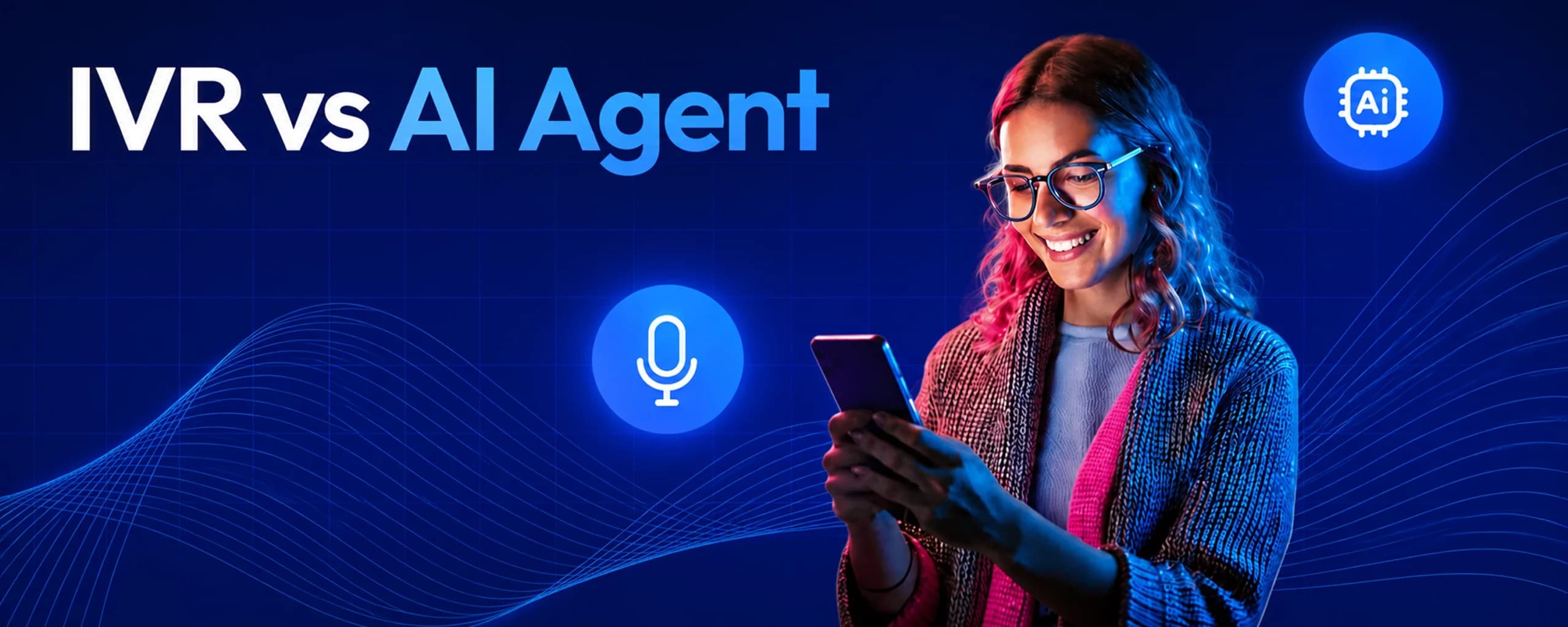
“Press 1 for sales, press 2 for support” has trained an entire generation of callers to dread automated phone systems. That experience is IVR, Interactive Voice Response, and it has been the default way businesses handle phone-based automation for decades. Voice AI is often mistaken for a newer version of the same thing. It is not.
The difference between voice AI and IVR is not just newer technology wrapped around an old idea. It is a fundamentally different approach to how a caller interacts with an automated system, what that system can actually do, and how much it costs a business to maintain.
This article breaks down exactly what separates the two, where each one still makes sense, and how to think about which approach fits your business.
What IVR Actually Is
IVR, or Interactive Voice Response, is the automated phone system technology that has answered business calls since the 1980s. It works by presenting callers with a fixed set of options, delivered through pre-recorded audio, and routing them based on keypad input or simple keyword matching.
- Menu-driven navigation is the core mechanic. Callers hear a list of options and respond with a number or a short spoken word that the system matches against a limited set of expected inputs.
- Fixed decision trees define every possible path through the system in advance. If a caller’s need does not match one of the pre-built branches, the system cannot adapt.
- No real language understanding. IVR does not parse meaning or intent. It matches specific inputs to specific outcomes, which is why callers who say something slightly off-script often get misrouted or stuck.
- Primarily inbound. IVR systems are built to receive and route calls, not to initiate natural conversations or handle outbound campaigns.
IVR has stuck around for decades because it is cheap to deploy for simple routing tasks and does not require any language modeling to function. Its limitations are also exactly why so many callers try to say “agent” or mash zero repeatedly to escape it.
What Voice AI Actually Is
Voice AI refers to systems that use natural language processing and speech recognition to understand what a caller is actually saying, and respond with a genuinely conversational reply, not a pre-recorded branch selection.
- Natural language understanding. Voice AI parses full sentences, not just keywords, which means a caller can explain their issue in their own words instead of hunting for the right menu option.
- Context and memory within a call. A voice AI system can track what has already been said earlier in the conversation and use that context to respond appropriately, rather than treating each input as an isolated event.
- Dynamic conversation paths. Instead of a fixed decision tree, voice AI can ask clarifying questions, handle unexpected input, and adjust its response in real time based on what the caller actually needs.
- Works both inbound and outbound. Voice AI can handle inbound support calls and also run outbound campaigns like appointment reminders, collections, or cold outreach, with human-like conversation on both ends.
- Sentiment and intent recognition. More advanced voice AI systems can pick up on caller frustration or urgency and adjust tone or escalate accordingly, something a static IVR menu cannot do at all.
The real distinction is not “AI” versus “no AI.” It’s whether the system understands what a person means, or just matches what they pressed.
The Core Differences, Side by Side
The gap between these two technologies becomes clearest when you compare how each one actually behaves during a call.
| Factor | Traditional IVR | Voice AI |
| Input understanding | Keypad input or fixed keyword matching | Full natural language understanding |
| Conversation style | Static menu tree | Dynamic, context-aware conversation |
| Handling unexpected requests | Fails or misroutes | Adapts and asks clarifying questions |
| Call direction | Primarily inbound | Inbound and outbound |
| Personalization | None, same script for every caller | Context-aware, can reference account history |
| Escalation to humans | Rule-based transfer, no context passed | Smart handoff with full conversation context |
| Setup and maintenance | Manual menu scripting for every change | Trained and updated on business data |
| Caller experience | Often frustrating, feels robotic | Designed to feel like a real conversation |
Why This Difference Actually Matters for a Business
The practical impact of choosing IVR versus voice AI shows up directly in customer experience, operational cost, and how much revenue a business is leaving on the table through poor call handling.
- Abandoned calls cost real revenue. Callers who get stuck in an IVR loop or cannot find the right menu option frequently hang up, and every one of those is a lost support resolution or a lost sales opportunity.
- Human agents cost significantly more to scale. A single human support or sales agent typically runs $40,000 to $60,000 a year, and scaling that across 24/7 coverage or multiple regions multiplies cost and complexity fast.
- IVR cannot personalize, which limits its usefulness for anything beyond basic routing. A returning customer with an open support ticket gets the exact same menu as a first-time caller, with no memory of prior context.
- Voice AI can resolve issues instead of just routing them. A well-trained voice AI system can actually answer a question, process a request, or complete a task, rather than simply directing the caller toward a human agent who then starts from scratch.
- Smart escalation preserves context. When a voice AI system does hand off to a human, it can pass along the full conversation history and sentiment read, so the caller does not have to repeat themselves.
When IVR Still Makes Sense
IVR is not obsolete, and it is worth being honest about where it still does the job well enough that replacing it is not a priority.
- Extremely simple, high-volume routing, like directing calls to the right department based on a single clear choice, still works fine on basic IVR.
- Low call complexity environments where every possible caller need genuinely fits into a small, fixed set of categories.
- Budget-constrained situations where the cost and setup time of a full voice AI deployment is not justified by current call volume or complexity.
The calculation changes quickly once call volume grows, caller needs diversify, or a business wants phone interactions to actually resolve issues rather than just redirect them.
Where Voice AI Is the Clear Upgrade
Voice AI becomes the stronger choice as soon as calls involve real problem-solving, personalization, or revenue-generating conversation rather than simple routing.
- Customer support lines handling varied, unpredictable questions that do not fit neatly into a menu structure.
- Outbound sales and cold calling, where a scripted IVR simply has no equivalent, since IVR cannot initiate or hold an actual sales conversation.
- Appointment scheduling, reminders, and collections, where a natural, human-like voice increases pickup rates and completion rates compared to a robotic recorded message.
- Multi-language or high-volume global support, where hiring and scaling human agents across time zones and languages becomes prohibitively expensive.
- Any business trying to reduce cost per interaction while actually improving the caller’s experience, rather than trading one for the other.
How Isometrik AI Fits In
Isometrik AI is built as complete infrastructure for both inbound and outbound campaigns, designed to hold human-like conversations at scale rather than route callers through a static menu.
- Human-like conversation across cold calling, support lines, and custom voice use cases, built to actually understand and respond to what a caller is saying.
- Context-aware and personalized, remembering conversation history and adapting tone rather than repeating the same script to every caller.
- Smart escalation to human teams, passing full context and sentiment tracking when a call needs a person, instead of a cold, contextless transfer.
- Enterprise-grade security, built SOC2 and GDPR compliant, so voice automation does not come at the cost of compliance.
- Deployable in 12-16 weeks, with proven results including 30-second average response times and roughly 60% lower cost per interaction compared to human-only staffing.
For businesses still running on legacy IVR, moving to voice AI is less about replacing a phone tree and more about turning the phone channel into something that can actually resolve issues, support customers, and generate revenue on its own.
Ready to Move Beyond IVR?
If your phone channel is still running on rigid, menu-driven IVR, it is likely costing you both callers and revenue. Isometrik AI’s Voice AI delivers human-like conversation across inbound and outbound calls, with smart escalation, enterprise-grade compliance, and deployment in as little as 12 weeks.
Book a free strategy call with our team to see how voice AI fits your business, or explore Isometrik’s full AI product suite to see what else can be automated.